

Program Transcript
Episode 39: 7 Feasts: Sukkot. His Final Dwelling Place
Heather M R Olsen
Welcome Friends,
As always, I’m grateful you have tuned in to hear God’s messages, God’s prophecies, fulfilled and yet to be fulfilled on Illumination.
We have journeyed from Passover, Unleavened Bread, First Fruits, Pentecost, Rosh HaShanah, Yom Kippur, and now the final mandated Feast, moed, the Festival of Sukkot, or Tabernacles/Booths.
Reminders:
Passover commemorated God miraculously taking the Israelites out of slavery in Egypt, escaping Pharoah and the Egyptian army. Fulfilled is the sacrifice of the final Passover Lamb in Jesus.
Unleavened Bread is nestled within Passover, exemplifying the mandate that absolutely no leavening agent or yeast was to be in the house or stomach of God’s people. This yeast, biblically signifying sin, was fulfilled in Jesus’ dead body, yet no sin was found in His undecaying body in the tomb.
First Fruits is the third day of Passover, a giving of the first harvest of barley to the LORD. This ceremony of thankfulness commemorated the gifts of sustenance given regularly, by
Him, but during this early spring festival—another gift given. On First Fruits, Jesus rose from the dead, proving His Power over not only disease, spiritual warfare, and other’s death, but Power over His own death. He was the first of fruits to rise bodily and permanently, and one day all believers will rise with Him.
Shavuot, or the Festival of Weeks, is also entitled Pentecost. This feast in antiquity commemorated the first of the wheat harvest, again a celebration of gratitude and giving back to the LORD. The greatest harvest to date also occurred on this 50th day after First Fruits in the 1st century: the harvest of 3000 believers as the Holy Spirit was released to the disciples awaiting this special event. The indwelling of the Holy Spirit was and is a new gift given to those who believe.
Fast forward to Fall, Yom Teruah, the Day of Sounding or Trumpets, also is entitled in contemporary culture, Rosh Hashanah, the head of the new year. This day marks the beginning of the Jewish year, but also the 10 Days of Awe, a season of personal reflection. Repentance and reconciliation are themes. Within this personal season of reflection and repentance, one can look ahead to Jesus’ second coming as the trumpet is sounded and He calls His people, the season of regathering.
Then Yom Kippur, the most solemn day of the Jewish year. This Day of Atonement, in antiquity, was the one day a year that the High Priest entered the Most Holy Place in the tabernacle or temple to atone for the people’s sins. We have a High Priest now, who permanently entered the Most Holy Place, and tore the massive curtain from top to bottom so we can all enter into God’s Holy Presence. An overlying theme then and now is making sure one is inscribed in the Book of Life. One day this Book will be closed permanently.
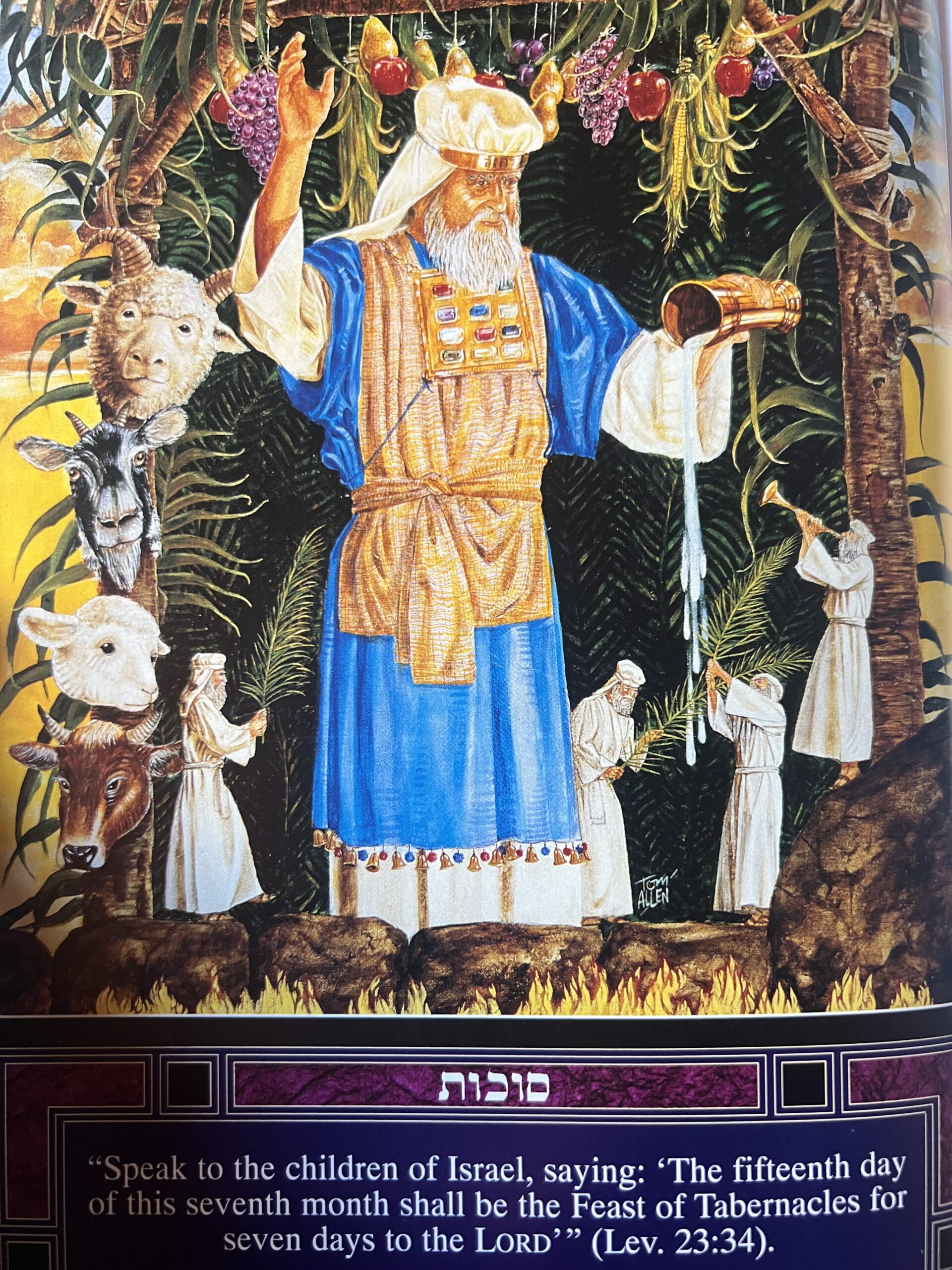
And now, last but certainly so joyous, is Sukkot, or Tabernacles.
But first our prayer from Psalm 90:12:
Father, Teach us to number our days, that we may gain a heart of wisdom.
In a nutshell:
- Sukkot or Tabernacles or Ingathering is the most JOYOUS day of the year.
- This holiday is an annual reminder of God’s continual provision. First, for 40 years in the wilderness/desert, and then, later, when all the crops would have been harvested and gathered.
- It is a reminder that our safety and security comes from God
- This holiday is a time of joy, feasting & fellowship.
- Plus, of course, there is a promise of Messianic fulfillment.
Let’s begin digging and start with scripture. We can read about Sukkot, or the Feast of Tabernacles, in:
- Leviticus 23:33-44
- Numbers 29:12-40
- Deuteronomy 16:13-17
I’m only going to read portions of these as there is minutia regarding sacrifices that we do not participate in today. Please go back and read them yourselves. God is a God of detail!
Leviticus 23:33-44 The Festival of Tabernacles
33 The Lord said to Moses, 34 “Say to the Israelites: ‘On the fifteenth day of the seventh month the Lord’s Festival of Tabernacles begins, and it lasts for seven days. 35 The first day is a sacred assembly; do no regular work. 36 For seven days present food offerings to the Lord, and on the eighth day hold a sacred assembly and present a food offering to the Lord. It is the closing special assembly; do no regular work.
37 (“‘These are the Lord’s appointed festivals, which you are to proclaim as sacred assemblies for bringing food offerings to the Lord—the burnt offerings and grain offerings, sacrifices and drink offerings required for each day. 38 These offerings are in addition to those for the Lord’s Sabbaths and in addition to your gifts and whatever you have vowed and all the freewill offerings you give to the Lord.)
39 “‘So beginning with the fifteenth day of the seventh month, after you have gathered the crops of the land, celebrate the festival to the Lord for seven days; the first day is a day of sabbath rest, and the eighth day also is a day of sabbath rest. 40 On the first day you are to take branches from luxuriant trees—from palms, willows and other leafy trees—and rejoice before the Lord your God for seven days. 41 Celebrate this as a festival to the Lord for seven days each year. This is to be a lasting ordinance for the generations to come; celebrate it in the seventh month. 42 Live in temporary shelters for seven days: All native-born Israelites are to live in such shelters 43 so your descendants will know that I had the Israelites live in temporary shelters when I brought them out of Egypt. I am the Lord your God.’”
44 So Moses announced to the Israelites the appointed festivals of the Lord.
Numbers 29:12-40
Reiterates the day and month, and a sacred assembly celebrating to the LORD for 7 days, complete with the first and eighth days as sabbaths.
Each day is then outlined in what was to be given or sacrificed to the LORD.
The Festival of Tabernacles
12 “‘On the fifteenth day of the seventh month, hold a sacred assembly and do no regular work. Celebrate a festival to the Lord for seven days. 13 Present as an aroma pleasing to the Lord a food offering consisting of a burnt offering of thirteen young bulls, two rams and fourteen male lambs a year old, all without defect. 14 With each of the thirteen bulls offer a grain offering of three-tenths of an ephah of the finest flour mixed with oil; with each of the two rams, two-tenths; 15 and with each of the fourteen lambs, one-tenth. 16 Include one male goat as a sin offering, in addition to the regular burnt offering with its grain offering and drink offering.
17 “‘On the second day offer twelve young bulls, two rams and fourteen male lambs a year old, all without defect. 18 With the bulls, rams and lambs, offer their grain offerings and drink offerings according to the number specified. 19 Include one male goat as a sin offering, in addition to the regular burnt offering with its grain offering, and their drink offerings.
20 “‘On the third day offer eleven bulls, two rams and fourteen male lambs a year old, all without defect. 21 With the bulls, rams and lambs, offer their grain offerings and drink offerings according to the number specified. 22 Include one male goat as a sin offering, in addition to the regular burnt offering with its grain offering and drink offering.
23 “‘On the fourth day offer ten bulls, two rams and fourteen male lambs a year old, all without defect. 24 With the bulls, rams and lambs, offer their grain offerings and drink offerings according to the number specified. 25 Include one male goat as a sin offering, in addition to the regular burnt offering with its grain offering and drink offering.
26 “‘On the fifth day offer nine bulls, two rams and fourteen male lambs a year old, all without defect. 27 With the bulls, rams and lambs, offer their grain offerings and drink offerings according to the number specified. 28 Include one male goat as a sin offering, in addition to the regular burnt offering with its grain offering and drink offering.
29 “‘On the sixth day offer eight bulls, two rams and fourteen male lambs a year old, all without defect. 30 With the bulls, rams and lambs, offer their grain offerings and drink offerings according to the number specified. 31 Include one male goat as a sin offering, in addition to the regular burnt offering with its grain offering and drink offering.
32 “‘On the seventh day offer seven bulls, two rams and fourteen male lambs a year old, all without defect. 33 With the bulls, rams and lambs, offer their grain offerings and drink offerings according to the number specified. 34 Include one male goat as a sin offering, in addition to the regular burnt offering with its grain offering and drink offering.
35 “‘On the eighth day hold a closing special assembly and do no regular work. 36 Present as an aroma pleasing to the Lord a food offering consisting of a burnt offering of one bull, one ram and seven male lambs a year old, all without defect. 37 With the bull, the ram and the lambs, offer their grain offerings and drink offerings according to the number specified. 38 Include one male goat as a sin offering, in addition to the regular burnt offering with its grain offering and drink offering.
39 “‘In addition to what you vow and your freewill offerings, offer these to the Lord at your appointed festivals: your burnt offerings, grain offerings, drink offerings and fellowship offerings.’”
40 Moses told the Israelites all that the Lord commanded him.
The third Torah explanation of Tabernacles is found in:
Deuteronomy 16:13-17
The Festival of Tabernacles
13 Celebrate the Festival of Tabernacles for seven days after you have gathered the produce of your threshing floor and your winepress. 14 Be joyful at your festival—you, your sons and daughters, your male and female servants, and the Levites, the foreigners, the fatherless and the widows who live in your towns. 15 For seven days celebrate the festival to the Lord your God at the place the Lord will choose. For the Lord your God will bless you in all your harvest and in all the work of your hands, and your joy will be complete.
We are then told about the 3 pilgrimage holidays, “shelosh regalim.”
16 Three times a year all your men must appear before the Lord your God at the place he will choose: at the Festival of Unleavened Bread, the Festival of Weeks and the Festival of Tabernacles. No one should appear before the Lord empty-handed: 17 Each of you must bring a gift in proportion to the way the Lord your God has blessed you.
Traditionally, 4 plant species are collected and used in this celebration. These four species or in Hebrew “arba minim,” are as follows, as interpreted from this more direct translation of the Hebrew Bible, the Messianic Bible.
Leviticus 23:40
“You shall take for yourselves on the first day [of the festival] the splendid fruit of a tree [etrog], palms of dates [lulav], the branch of the thickly leafed tree [hadas], and willows [aravot] of the brook.”
These 4 species are an etrog (citron- a large lemon-like fruit, the splendid fruit of a tree, a lulav (a date palm branch), three hadassim (these are the thickly leaved trees, which are myrtle twigs) and two aravot (these are willows of the brook, or willow twigs). They are bound together so they’re easily held in one hand.
The lulav, hadassim, and aravot are first taken up with the right hand, and then the etrog is taken with the left hand. A blessing is recited over the Four Species.
A fun hands-on command of God’s is the building of a Sukkah: in short, a hut that provides shade.
From a Jewish orthodox website, Chabad.org, we can learn lots of pertinent information.
The building of a sukkah can vary depending on a person’s Jewish orthodoxy, but in short, it’s commonly three sides of any material, with natural material on top to see the sky/stars, yet enough to provide shade. “Common sukkah roof-coverings are: bamboo poles, evergreen branches, reeds, corn stalks, narrow strips of unfinished lumber, or special mats.” The roof, entitled the sechach, is to be made of something from the ground.
Indoor furnishings include a table, chairs, children’s decorations and some sort of lighting. One is to dine in the sukkah for 7 days, and sleeping inside is also common (Chabad.org).
Besides the physical symbols, there are several other motifs incorporated in this holiday. They are water, light, the completion of the reading of the Torah, and hospitality is strongly interwoven throughout.
We can read about a celebration of Sukkot in the Hebrew Bible. King Solomon dedicated the newly built temple during this joyful holiday in 2 Chronicles 5.
2 Chronicles 5:3 And all the Israelites came together to the king at the time of the festival in the seventh month.
All of the sacred articles were ceremonially brought from the tabernacle to this spectacular temple. All the priests were consecrated, 120 trumpeters, cymbals, musicians, praise, and joy! Then something special happened during the dedication,
2 Chron. 5:13-14:
The temple of the Lord was filled with the cloud, 14 and the priests could not perform their service because of the cloud, for the glory of the Lord filled the temple of God.
God was pleased and had manifested Himself as a dense cloud in the temple. God’s manifestation in the Bible is called a theophany, or His Shekinah.
I talk about shekinah in Illumination’s Theophany Podcast, but the shoresh, or root, of the Hebrew term shekinah is shachan. Shachan means “to dwell.” שׁכן
The Hebrew word for Tabernacle comes from this same shoresh, “mishcan.” מִשׁכָּן= tabernacle
שְׁכִינָה = God’s glory… God dwelling with us. In English, we say Shekinah.
Tabernacle. Dwelling. Mishchan. God’s Glory. God’s dwelling. They all intertwine throughout this holiday.
The definition of Tabernacle from the Merriam-Webster Dictionary is:
*a tent sanctuary used by the Israelites during the Exodus
* a dwelling place or temporary shelter
Tabernacle can also come in the verb form:
tabernacled; tabernacling: to take up temporary residence.
especially: to inhabit a physical body
The verb about inhabiting a physical body would be the Holy Spirit’s dwelling, released at Pentecost, or Shavuot! So amazing.
This Holy Spirit tabernacles in the hearts of all who believe.
Sukkot commemorates God’s own Sukkah within the Israelite people, the actual Tabernacle. It was portable and impermanent. It served in the center of the Israelite community.
When the temple was constructed, God’s Glory resided in the Holy of Holies; a new kind of tabernacling.
Around the 1st century, God came in the body of Jesus to live among us.
VanLoon writes that Sukkot points to the first coming of Jesus as he was born in a temporary dwelling in Bethlehem.
He came as Immanuel—Im: with, noo: us, El: God. God with us—Immanuel.
In fact, scholars believe that Yeshua actually was born at the end of September/early October during Sukkot rather than December 25th. That will be another podcast but, for now, it’s food for thought.
The Apostle John began his gospel spelling out Jesus’ origins.
1 In the beginning was the Word, and the Word was with God, and the Word was God. 2 He was with God in the beginning. 3 Through him all things were made; without him nothing was made that has been made. 4 In him was life, and that life was the light of all mankind. 5 The light shines in the darkness, and the darkness has not overcome it.
He continued in,
John 1:14 The Word became flesh and made his dwelling among us. We have seen his glory, the glory of the one and only Son, who came from the Father, full of grace and truth.
Tabernacle (Jesus’ dwelling here among us) and Shekinah (We have seen God’s Glory)—this ancient language is in the John 1:14 passage!
Yeshua is the ultimate visible manifestation of God’s Glory to date—God in human form.
We can go on in Yeshua’s life to the Transfiguration. Find it in Matthew 17, Mark 9, Luke 9. Jesus, Moses and Elijah appear before Peter, James, and John. Peter blurts out that they should make three booths for them. The Greek word for “booth” is skene, meaning “tabernacle, tabernacles, dwellings, tents.”
Van Loon reflects that “Peter’s nervous words reflect his deep longing for God to move into the neighborhood once and for all.”
For Moses, Elijah, & Jesus to appear together, God was giving a prophetic message that encircled the Torah/Law through Moses and the Prophets through Elijah, with the New Covenant brought by Jesus.
Jesus fulfilled the Torah and Prophets and initiated His new covenant.
Let’s move to the Water Drawing Ceremony.
Isaiah 12:3 With joy you will draw water from the wells of salvation.
Jesus adhered to this water tradition as He often used a metaphor of water when pertaining to the eternal life with Him.
In John 4, Jesus spoke with a Samaritan woman at a well, during high noon. He said, “If you knew the gift of God and who it is that asks you for a drink, you would have asked him and he would have given you living water.”
Jesus also said, “Everyone who drinks this water will be thirsty again, 14 but whoever drinks the water I give them will never thirst. Indeed, the water I give them will become in them a spring of water welling up to eternal life.”
Jesus prophesied the following passage, during Sukkot:
John 7:37-46 37 On the last and greatest day of the festival, Jesus stood and said in a loud voice, “Let anyone who is thirsty come to me and drink. 38 Whoever believes in me, as Scripture has said, rivers of living water will flow from within them.” 39 By this he meant the Spirit, whom those who believed in him were later to receive. Up to that time the Spirit had not been given, since Jesus had not yet been glorified.
40 On hearing his words, some of the people said, “Surely this man is the Prophet.”
41 Others said, “He is the Messiah.”
Still others asked, “How can the Messiah come from Galilee? 42 Does not Scripture say that the Messiah will come from David’s descendants and from Bethlehem, the town where David lived?” 43 Thus the people were divided because of Jesus.
Remember when Jesus was born and the magi were following the unprecedented star? They stopped in Jerusalem to inquire where the newborn king had been born. The highest educated religious leaders recited the Micah prophecy to King Herod, that the newborn king would be born in Bethlehem.
And yet fast forward 30-ish years, and nobody made the connection. Nobody stopped and inquired where Jesus had been born. They assumed since He grew up in Nazareth, that was His birthplace. Anyone could have asked Him; or one of the disciples.
This is yet another reminder to not only know the prophecies but to keep an open mind in how God will fulfill them!
In the Land of Jesus’ time, there were 3 kinds of fresh water: cisterns, wells, and open springs.
Living water meant waters with movement, the most valuable water source. It was pure and would not dry up. This perfectly fits Jesus’ use of the metaphor of His love and gift.
Continuing with water metaphors, both Jeremiah and Isaiah issued God’s warnings regarding the people prior to deportation.
Jeremiah 2:13 “My people have committed two sins: They have forsaken me, the spring of living water, and have dug their own cisterns, broken cisterns that cannot hold water.”
Isaiah 44:3 For I will pour water on the thirsty land, and streams on the dry ground; I will pour out my Spirit on your offspring, and my blessing on your descendants.
Jesus is the Living Water that brings relationship and eternal life with Him.
Let’s pivot to the hospitality theme in Sukkot.
There is a delightfully corny movie about this holiday which instills this mandate of Sukkot hospitality entitled Ushpizin, which means “Guests” in Aramaic. The movie is in Hebrew but dubbed in English, and is about a couple, Moshe and Mali, who are struggling financially. Two unexpected visitors arrive. Due to biblical tradition, they are obligated to share their Sukkah and festival with these guests. I won’t give away more, but it will help you visualize this holiday plus hopefully make you smile.
Hospitality actually goes back to the days of Abraham in Genesis 18, when he welcomed three visitors. Abraham offered these three supernatural men water to wash their feet, freshly baked bread, the finest roasted calf, curds and milk. They brought a message that at this time the following year, Sarah would deliver a baby (she laughed).
Strangers were to be treated like honored guests and Abraham & Sarah modeled this.
Yet this is not just a Hebrew Bible or Orthodox Jewish tradition. We can read in,
Hebrews 13:2 Do not forget to show hospitality to strangers for by so doing some people have shown hospitality to angels without knowing it.
This is a mandate for all of us who believe!
We don’t need a huge house, large table, a five-course meal, fancy new recipes, or fine wine.
Merely gathering around the table with simple food and conversation is beautiful and bonding.
Back to scripture:
The Hallel Psalms are read again.
We first learned about them in the Passover ceremony.
Again, bookends—Psalms 113-118 are read for the first and last of God’s holidays.
Psalm 118 is a messianic Psalm. I encourage you to read the entire Psalm but here are some phrases.
Give thanks to the Lord, for he is good; his love endures forever.
The word LOVE in this passage is actually Chesed. If you don’t know that character quality of God’s, please listen to the Shalom vay Chesed podcast.
It’s a complex and powerful word that God uses to describe Himself and that others use to describe God.
8 It is better to take refuge in the Lord
than to trust in humans.
14 The Lord is my strength and my defense;
he has become my salvation. (YESHUA)
17 I will not die but live,
and will proclaim what the Lord has done.
19 Open for me the gates of the righteous;
I will enter and give thanks to the Lord.
20 This is the gate of the Lord through which the righteous may enter.
21 I will give you thanks, for you answered me;
you have become my salvation.
22 The stone the builders rejected has become the cornerstone;
23 the Lord has done this, and it is marvelous in our eyes.
24 The Lord has done it this very day; let us rejoice today and be glad.
25 Lord, save us! (HOSHIANA)
26 Blessed is he who comes in the name of the Lord.
27 The Lord is God, and he has made his light shine on us.
With boughs in hand, join in the festal procession
29 Give thanks to the Lord, for he is good; his chesed endures forever.
Similar palm branches were waved, with a “save us,” “hoshiana,” or “hosannah” motif.
We can fast forward from the Psalms to Revelation and read more of this motif.
Revelation 7:9-10
9 After this I looked, and there before me was a great multitude that no one could count, from every nation, tribe, people and language, standing before the throne and before the Lamb. They were wearing white robes and were holding palm branches in their hands. 10 And they cried out in a loud voice: “Salvation belongs to our God, who sits on the throne, and to the Lamb.”
More salvation language.
And it came from God through Jesus, the Lamb.
In Hebrew, the shoresh of Yeshua is:
- Yasha ישע he saved
- ישׁוע Jesus: Yeshua: salvation or salvation from God
When you read the word “salvation” in the Bible, it’s shoresh is the same as Jesus’ name. Think of Yeshua when you read salvation!
Continuing, light is prevalent in this joyous holiday.
Light is prophesied as a descent of God’s Glory—Shekinah
We can read that God’s Glory returns to the temple in,
Ezekiel 43:1-6
43 Then the man brought me to the gate facing east, 2 and I saw the glory of the God of Israel coming from the east. His voice was like the roar of rushing waters, and the land was radiant with his glory. 3 The vision I saw was like the vision I had seen when he came to destroy the city and like the visions I had seen by the Kebar River, and I fell facedown. 4 The glory of the Lord entered the temple through the gate facing east. 5 Then the Spirit lifted me up and brought me into the inner court, and the glory of the Lord filled the temple. 6 While the man was standing beside me, I heard someone speaking to me from inside the temple.
John recorded Jesus’s words in:
John 8:12 “I am the light of the world. Whoever follows me will never walk in darkness but will have the light of life.”
John 9:5 “While I am in the world, I am the light of the world.”
Jesus is our Light and our Source!
Water, Light, Hospitality… but there’s one final commemoration.
The day after Sukkot—day 9—religious Jewish people today celebrate Simchat Torah, which is translated as rejoicing in the Torah. This is an annual celebration of completing the reading of the Torah. Joyful dancing around the synagogue is typical.
Yet, horrifically, it was on this very holiday of Simchat Torah, that Israel was attacked by terrorists and militants on 10/7/2023. With almost 1200 slaughtered and nearly 250 people taken hostage, joy has turned to intense sorrow this day.
We’ll wrap up with the final day of ingathering of believers and God tabernacling with His people permanently.
Believe it or not, Jesus’ first coming was the beginning of the end. So here is how the end begins.
One day, Jesus will bodily return and rule over Heaven and Earth for good. We’ve begun that part of His narrative with Rosh HaShanah and Yom Kippur.
This is the Second Coming.
Sukkot’s future fulfillment is preceded by:
- The trumpet sounding and Jesus coming.
- The Final judgment, ensuring our names are in the book of Life.
- The remnant of Israel (believers) gathered as Gentile believers are gathered as well.
God has promised repeatedly that He would come and dwell with His people again. He will one day again Tabernacle with us—this time permanently. God’s story of redemption in the Bible comes full circle back to the Beginning in the Garden, but now with evil forever destroyed.
Hear some prophecy:
Zechariah 14:16-17
16 Then the survivors from all the nations that have attacked Jerusalem will go up year after year to worship the King, the Lord Almighty, and to celebrate the Festival of Tabernacles. 17 If any of the peoples of the earth do not go up to Jerusalem to worship the King, the Lord Almighty, they will have no rain.
Rev 21:1-4 Then I saw “a new heaven and a new earth,” for the first heaven and the first earth had passed away, and there was no longer any sea. 2 I saw the Holy City, the new Jerusalem, coming down out of heaven from God, prepared as a bride beautifully dressed for her husband. 3 And I heard a loud voice from the throne saying, “Look! God’s dwelling place is now among the people, and he will dwell with them. They will be his people, and God himself will be with them and be their God. 4 ‘He will wipe every tear from their eyes. There will be no more death’ or mourning or crying or pain, for the old order of things has passed away.”
Rev 5:9b With your blood you purchased for God persons from every tribe and language and people and nation.
Return of the King, “Everything sad will become untrue!” (M&D 87)
As believers, this will be our end.
“Everything sad will become untrue.”
More prophecy:
Revelation 21:22-27
22 I did not see a temple in the city, because the Lord God Almighty and the Lamb are its temple. 23 The city does not need the sun or the moon to shine on it, for the glory of God gives it light, and the Lamb is its lamp. 24 The nations will walk by its light, and the kings of the earth will bring their splendor into it. 25 On no day will its gates ever be shut, for there will be no night there. 26 The glory and honor of the nations will be brought into it. 27 Nothing impure will ever enter it, nor will anyone who does what is shameful or deceitful, but only those whose names are written in the Lamb’s book of life.
Rev 22:1-5
Eden Restored
22 Then the angel showed me the river of the water of life, as clear as crystal, flowing from the throne of God and of the Lamb 2 down the middle of the great street of the city. On each side of the river stood the tree of life, bearing twelve crops of fruit, yielding its fruit every month. And the leaves of the tree are for the healing of the nations. 3 No longer will there be any curse. The throne of God and of the Lamb will be in the city, and his servants will serve him. 4 They will see his face, and his name will be on their foreheads. 5 There will be no more night. They will not need the light of a lamp or the light of the sun, for the Lord God will give them light. And they will reign for ever and ever.
12 “Look, I am coming soon! My reward is with me, and I will give to each person according to what they have done. 13 I am the Alpha and the Omega, the First and the Last, the Beginning and the End.
14 “Blessed are those who wash their robes, that they may have the right to the tree of life and may go through the gates into the city.
17 The Spirit and the bride say, “Come!” And let the one who hears say, “Come!” Let the one who is thirsty come; and let the one who wishes take the free gift of the water of life.
- Jesus came. He tabernacled with us in the 1st century. He ushered in the New Covenant.
- The Holy Spirit came and still comes. This Ruach, or Spirit, tabernacles inside all who believe in the saving life of Yeshua.
- Jesus is coming again, to set up and reign on the New Heaven and New Earth
- Matthew 24:42 “Therefore keep watch, because you do not know on what day your Lord will come.”
- Eden will be restored. Evil will be vanquished.
- Take the free gift of the Water of Life.
And the most comforting part of the message is that in the end, God wins! Period.
Adonai Hoshiana!
Lord, save us!!!
**Heather!
©2025 Heather M R Olsen, Illumination: Hebrew Insights. All rights reserved.

