

Program Transcript
Episode 44: The Incarnation in Historical Context
Heather M R Olsen

Welcome Illumination listeners,
What a treasure it is to walk through the Advent and Christmas Seasons with you. I pray that the things learned, both cognitively and spiritually, continue to enrich your walk with Jesus and journey with God.
We are in a short series that incorporates both Advent and Christmas as we ready our hearts for the celebration of the Incarnation. I recently reposted my “Prophecy Fulfilled” episode from last year. As I listened to it—and while it is painful listening to one’s own voice—I was struck by how much I have learned in this year of reading, researching, and grappling. This Historical Birth Story episode won’t necessarily contradict some facts but will deepen them into a greater knowledge of the 1st century.
Why do ancient facts and the modern Nativity story differ? I choose to believe the best in humanity and history, so my thoughts are thus.
First, not knowing ancient languages, many people read the words in the Bible and believe that is exactly what and how the details were written. Translators have studied and diligently worked with ancient manuscripts, some incomplete, to put out the very best rendition of the text.
Secondarily, these facts and details are applied to one’s own time period. Remember the world 2000 years ago was dramatically different from our world today. The ancient near east – in writings and thoughts, history and genealogies – approached details and life in a unique way, unlike our modern western world.
Third, take artists: visual, literary, musical. The process of expressing their art is painstakingly put into a medium, but again most often is reflected in that artist’s contemporary time. Artistic expression is powerful and to be validated, so having the ability to separate the beauty of art, and facts is important. I will repost 2 devotionals I submitted to the Illumination podcast last December. They were written in the first person about these very narratives I talk about today. The author, Ken Gire, draws us in as though we are at the birth of the Messiah. Yet he uses details from modernity. Is there anything wrong with this? Not at all. I love his devotionals and his artistry brings me closer to Jesus.
It is also important to remember that the following facts are not salvation breakers. None of our Nativity sets, or church messages or art work are intended to draw us away from the Messiah. We are all on our journey to becoming closer to and more like Jesus, and most forms of artistic expression regarding the Incarnation carry that intention.
But I do acknowledge that some listeners don’t want to mess with one’s thoughts about what Christmas night was like. We picture Silent Night, Holy Night, and the sereness and solitude that was there that miraculous night 2000 years ago.
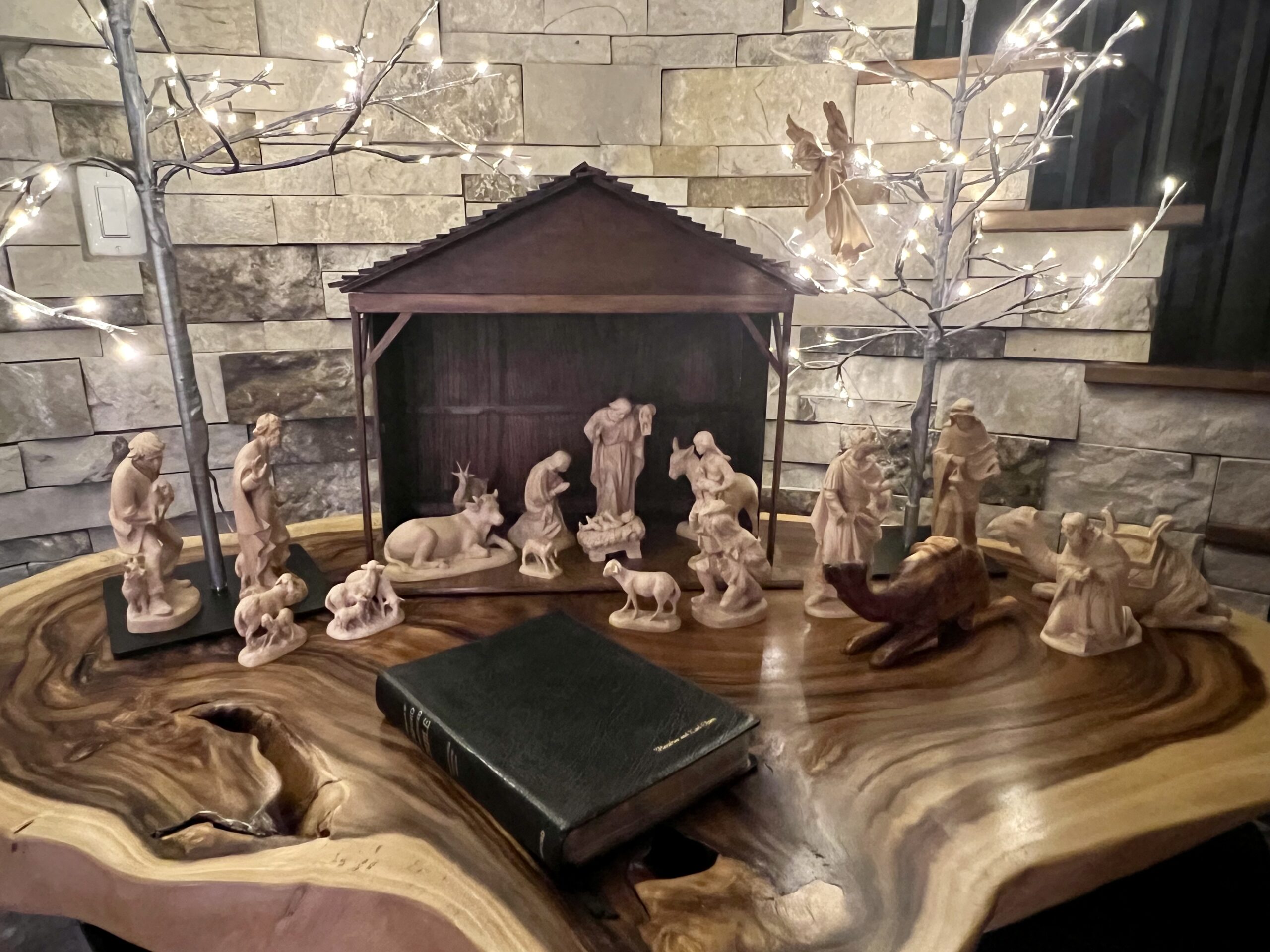
If you want to stay in that memory, that’s just fine. My Nativity set is a perfect picture of Mary and Joseph with Baby Jesus in a wooden stable. Karl actually built our small stable for our second Christmas as a married couple. He did meticulous work!
In this scene, the Holy Family is surrounded by sheep, a cow, a donkey, and a goat. I have four shepherds who sit outside the stable in worship, and of course the three kings with two camels are placed further away. I also have an angel that I hang up in a Christmas tree near the stable.
This serene, beautiful night is one of peace and harmony, and that may be enough for some of us. That’s ok. I was recently told by a friend that her husband doesn’t want to visit Bethlehem because he wants to preserve the serene and holy night of the Incarnation in his memory. He doesn’t want modernity and cultural influences to change his thoughts. I completely understand and validate that.
However, if you want to dig into the biblical and historical context of the 1st century, please journey with me now.
Let’s begin with the Gospel writers. Matthew and Luke combine to give us the birth story. John mainly focused on the eight signs proving that Jesus was the Son of God who imparts eternal life to all who believe in Him. Mark was the first Gospel written as well as the shortest, and, though Matthew and Luke took much material from Mark, he personally chose not to include the birth narrative. Mark’s gospel is the most action packed, complete with colorful adjectives, and he records the most miracles.
Both Matthew and Luke contain genealogies of Jesus’. Matthew traces Jesus back through King David to Abraham, the Father of God’s People—Israel. Jesus as their Descendant proved God kept His promises given in the Davidic and Abrahamic covenants. God always keeps His Promises!
Matthew’s genealogy is partitioned into three sections, each made of 14 descendants or generations, “toledot” [תּוֹלְדֹת] in Hebrew. Matthew spelled this out for us in Matthew 1:17, “Thus there were 14 generations in all from Abraham to David, fourteen from David to the exile to Babylon and fourteen from the exile to the Messiah.”
Though you and I may read these names and decide this lineage is inaccurate due to many generations missing, it is important to remember that “father of” also means “ancestor of” within the ancient near-east mindset. It is well known among Bible scholars that Matthew did not create an exhaustive list of descendants but rather hit the highlights in a meaningful way.
Within the Jewish people, who you came from defined who you were and proved one’s Jewish standing. Jesus being from Abraham and David fulfilled biblical prophecies, proving Jesus’ messiah status. That’s what Matthew spells out in these three sections of genealogy.
In ancient Judaism and the Bible, a literary tool entitled “Gematria” is used. Gematria is “the practice of assigning a numerical value to a name, word, or phrase.” As Matthew was writing to Jewish believers, or Messianic Jews, he used meaningful Jewish literary techniques. The use of Gematria is common throughout the Bible and is especially used by the Apostle John.
Let’s unpack Gematria in Matthew’s genealogy. He used three sections of 14 “toledot,” or generations as an added message using simple math. The Hebrew letter, “dalet” (D) is represented by the number 4. The Hebrew letter “vav” (V) is represented by the number 6. Then back to the “dalet” (D, or 4); 4 + 6 + 4 = 14. The mathematical equivalence of 14 for the letters “D” “V” “D” spells out David. Ancient Hebrew (and also modern Hebrew) both formally use no vowels, so this would be the appropriate way to spell King David’s name: DVD.
Matthew offers this up three times, three sets of 14 ancestors; 3, the number for “completeness or perfection.” Matthew very clearly established Jesus as the true royal Messiah, the son of David, the son of Abraham, which he openly stated in Matthew 1:1. This list of humans exemplifies the good, the bad, and the ugly as we have witnessed in many of the biblical narratives.
Little Heather couldn’t understand this. Why would God include such flawed people in His family? I wanted perfect stories to emanate. Little Heather also couldn’t understand this ultra boring chapter in the Gospel. Who cares? We never read this chapter in church anyway. Grown-up Heather now understands—both about the flawed people and this important genealogy. I needed to remember that there is only one perfect human in our Bibles. And this genealogy is all about Him.
Matthew’s genealogy also lists five women: Rahab, Tamar, Ruth, the wife of Uriah (Bathsheba), and Mary. This is unusual in a Jewish lineage, and more so, four of these women were not upright people, and furthermore, two were confirmed Gentiles. What was God doing through Matthew here? We understand that Jesus was related to all the Jews. But now we get a peek at His inclusion of Gentiles and the importance of women in His kingdom.
In contrast, Luke’s genealogy in Luke 3 beginning in verse 23 goes back to Adam, the first man (“adam” meaning man in Hebrew). This proved Jesus is related to all humans, being the fully human and fully God Savior of the world.
So, let’s begin our birth story.
To be honest, there are many misconceptions and assumptions that play out in the birth narrative and the nativity. I like to go back to the Bible as a purist.
We’ll begin at the beginning (after the genealogies).
The Roman Emperor, Caesar Augustus, also known as Octavian, was the first Roman emperor and founder of the Roman Empire. To put him into historical context, his great uncle and adoptive father was Julius Caesar. After Julius Caesar’s death, through years of power struggles, Octavian, or Caesar Augustus, ascended as heir to the throne. “The Roman Senate honored him with the title Augustus, which means “reverend,” “the exalted,” or “the venerable.” He ruled from 27 BC to 14 AD.
It was during his life that he issued this order, a Roman decree, that the entire empire was to go to their birth cities to register. Rome was taking a census. Unbeknownst to this pagan Roman emperor, he was a conduit for God’s prophecy through Micah and this census decree enabled the fulfillment of the prophecy from Micah 5:2,
“But you, Bethlehem Ephrathah, though you are small among the clans of Judah, out of you will come for me one who will be ruler over Israel, whose origins are from of old, from ancient times.”
It was common knowledge among the Jewish educated that the Messiah would be born in Bethlehem.
As we journey, I will flip back and forth between the Hebrew and English names of our characters.
- We have Yosef—Joseph
- Miriam—Mary
- Melekh David—King David
- Beth Lechem—Bethlehem
- Yerushalaim—Jerusalem
- Melekh Tzedek—Melchizedek
- And of course, Yeshua—Jesus
And so, God’s story continues.
Since Joseph “Yosef” was of the tribe of Judah, or “Yehudah,” and of the ancestry of King David “Melekh David,” whose hometown and lineage was Bethlehem, Joseph would have obeyed this Roman decree and traveled from Nazareth where he had been currently living to Bethlehem. By car today, it would have taken just under 2 hours. By foot, 90 miles in a straight shot south would have taken up to four days. Yet Joseph and Mary wouldn’t have taken a direct route from Nazareth to Bethlehem; they would have had to cut through Samaria. No respectable Jew would have traveled through Samaria. Jewish people would have gone east to the Jordan river then traveled south along the water, then head back west to Bethlehem.
Surprisingly, there is no mention of Mary riding on a donkey as they traveled to Bethlehem—that shocked me! There is also no mention that she was in her 3rd trimester or close to term while traveling. It would have been crazy for her to travel in the 8th month or later. We only glean from Luke 2:5 that “He [Joseph] went there [to Bethlehem] to register with Mary, who was pledged to be married to him and was expecting a child.” Mary’s gestation is only insinuated in the gospel of Luke when God told her through the angel Gabriel that she would conceive by the Holy Spirit. She then “hurried to a town in the hill country of Judea,” Luke 1:39 to her cousin Elizabeth’s home who was already six months pregnant. “Mary stayed with Elizabeth for about three months and then returned home.” Luke 1:56
I theorize that there was little likelihood that Mary would have left Elizabeth at the time Elizabeth was giving birth, so my conclusion is that Mary stayed for this momentous birth as she navigated her own first trimester. After this, she returned home. We can also connect the dots that information regarding both the births of Jesus and John the Baptist was passed along to Gospel writers by Mary.
Moving on, Mary was between three and nine months when she and Joseph trekked to Bethlehem. We don’t know if her pregnancy went to term, only that her time came to deliver while she was in Bethlehem. We don’t even know that she gave birth the night she arrived. But honestly, her gestation, the birth date—they aren’t relevant because as Luke records in Luke 1:37, “For no word from God will ever fail.” God had planned since the beginning of time that Jesus would be born in Bethlehem, at this time, at this place, a live birth, quiet and humble. With Joseph’s ancestry in Bethlehem, as well as strong Jewish hospitality, it is highly likely that Mary had many female attendants at the birth.
I found an article on the Biblical Archaeology website that speaks of the population of Bethlehem:
“The reality is that Bethlehem of Judea was one of numerous small villages that surrounded Jerusalem in the first century; [archaeologist] William F. Albright estimated that it had a population of about 300 people when Jesus was born.17 That Jesus was born in a small, out-of-the-way village would certainly be consistent with the humble way our Savior entered the world. Yet at the same time it is significant that the King who would reign forever on David’s throne (Luke 1:32-33) [as prophesied and promised in God’s Covenant to King David]. [Jesus] was born in the town that David himself grew up in.”
Rather than being born in a wooden stable, or stone cave, we only have a reference to animals in attendance because Jesus was laid in a manger. We do know that “She [Mary] wrapped him in cloths and placed him in a manger, because there was no guest room available for them.” It is likely that Jesus was born in a home, but the guest room in this home was unavailable, so, instead, they occupied the animal section of the home, with the manger as an available cradle. In Matthew 2:1, with the visit of the Magi, we can read about the Greek word, οἰκία (oikia) meaning “residence, abode, household.” This supports Jesus’ birth in a home.
Harry Wendt wrote in his Bible study, Christmas the Real Story, that,
“Traditionally, even in a one room house, there were 2 sections. The family lived in one section and the animals at night were brought into a second section. With animals inside their part of the home, they provided body heat and were protected from the elements or being stolen. This way, a lamp would actually light the entire house if it were only one room. People slept on mats rather than beds, and the mats were rolled up during the day.”
Both Mary and Joseph—separately—were instructed by God through Angel Gabriel what name they should give the baby. The angel speaking to Joseph is recorded in Matthew 1:21 “She will bear a son, and you shall call his name Jesus, for he will save his people from their sins.” Recorded in Luke 1:30-31 to Mary, we read, “And the angel [Gabriel] said to her, “Do not be afraid, Mary, for you have found favor with God. And behold, you will conceive in your womb and bear a son, and you shall call his name Jesus.”
Typical of this time period, a Jewish family would issue a family name. They did. Jesus’ name, “Yeshua” in Hebrew, means “Salvation” or “Salvation from God.” This family name came from the lineage of יהוה “YHWH”, as Savior of the world or Salvation for all people.
Mary and Joseph obediently named their son, and we can read in Matthew 1:25 But [Joseph] knew her not until she had given birth to a son. And he called his name Jesus. This newborn “Salvation” was of the Davidic dynasty, the tribe of Judah, the kingly tribe as prophesied. Please listen to the “Davidic Covenant” podcast. God promised King David that one Greater than him, the Messiah would come through his line. Yeshua was also a priest in order of Melchizedek (Melekh Tzadek), a mysterious priest not from the Levitical tribe.
The time of year of the Birth story is a conundrum. Why don’t we know Jesus’ birthday? Didn’t Jesus’ 1st century parents roll out the birthday cake each year? Surprisingly, birthdays were not recorded nor celebrated among the general Jewish population during Jesus’ time. Infant mortality was high, and birthday celebrations were attributed to ancient and pagan Egyptians and high-ranking Romans. These pagan nations were not to be emanated.
Consequently, among 1st century Jews, birthdays were not recorded, and we have little evidence in the Gospels regarding any semblance of a date. In contrast, there is meticulous evidence regarding Jesus’ trial, death and resurrection. Perhaps God orchestrated this to instill the importance of events. Of course, Jesus’ miraculous birth was important, but exponentially more so, His choice to go to the cross for humanity and Yeshua’s power over sin and death to raise Himself bodily.
But that’s another podcast. Back to the Christmas date.
December 25th was a chosen date under Emperor Constantine in the 4th century rather than it being a likely time of year for the Messiah’s birth. The pagan celebrations of the winter solstice already occupied this time period, and celebrations of the sun were rampant. One scholar recognizes that the Light of the World was born during this period of the shortest day of the year becoming longer again; the sun returning once again to the world.
Some say this date would protect Christians who celebrated Jesus rather than the sun, to celebrate in safety, but Constantine had already made Christianity legal. What’s more likely is that this Christian and pagan holiday were paired as a possibility of witnessing or capturing pagans for Christ.
Some scholars place Jesus’ birth during Sukkot, the end of September, by doing math regarding Zechariah and Elizabeth’s pregnancy surrounding John the Baptist. This holiday instilled by God, named Sukkot, is celebrated as little tabernacles, or booths, were erected to remember the Israelites 40 years in the wilderness and God’s miraculous provision and protection. Sukkot also symbolized God tabernacling with His People.
At the Incarnation, Jesus came to tabernacle with His people in the 1st century; and yet He will come again, believed to also be at Sukkot, to permanently tabernacle or dwell with His people at His 2nd coming. Further, regarding the shepherds in the fields, December is winter and the rainy season in Judea. The shepherds would more likely be out in the spring or the fall as sheep would be penned in the cold and rain. Additionally, the very efficient Romans would likely have had their Jewish constituents traveling during a time of year they would have already been traveling—during a pilgrimage holiday.
Other scholars guesstimate that Jesus was born in the lambing season in the spring. It’s fun speculation but not a salvation breaker and certainly nothing to debate.
Just enjoy the wonder!
The Heavenly Birth announcement came next. First, we can read that an Angel of the Lord stood by the shepherds, and the Glory of the Lord had shown around them. I never pictured an angel on the ground in this narrative. This Angel of the LORD shows up throughout the Hebrew Bible and does God’s bidding, whether simple face-to-face messages, or striking down enemies, destroying Jerusalem, or guiding and protecting.
Regardless, this nameless Angel of the Lord terrifies many in the Bible.
I had a piece of art—a picture of a beautiful, serene angel, with long blonde Hollywood waves in her hair, large wings, and a long flowing gown, protecting a frightened child as she crossed a bridge. Of course, that picture is made to comfort in that artistic rendition. But let’s be honest, I doubt she is what these angels looked like when they proclaimed, “Don’t be afraid!”
The first visitors of the baby were shepherds: dirty, smelly, culturally meek, and low in status. They worked on Shabbat and often took their flock to graze on land owned by others. Interestingly and sadly, they could not give a testimony in court, nor enter the temple in Jerusalem. And yet, God sent this multitude of angels with His Glory surrounding them, to tell of the child.
This Glory of the Lord, or יהוה, was believed to reside in the Holy of Holies in the temple. And yet, here He was! Outside of the temple, among the shepherds and angels, in the Incarnate Jesus. These shepherd outcasts praised God immediately and unhesitatingly. How often do we respond to God’s miracles this way? God had entered the world through a “back door,” quiet way, not with the large pomp and circumstance due Him. And with these first visitors as shepherds,God was showing that all are invited. Interestingly, God and Jesus are repeatedly recorded as shepherds of their flocks.
Jesus’ swaddling clothes would have resembled the way temple lambs in the fields around Jerusalem were wrapped at birth, so as not to get blemished in their newborn clumsiness. These particular shepherds working the fields around Jerusalem and Bethlehem could easily have been temple shepherds, raising these lambs and sheep for the sacrificial lambs at the temple. These outcasts who raised temple lambs got to see the Lamb of God first.
The 2nd named visitors were the Magi. We dissected the Three Wise Men, or Magi, in episode 1 of Illumination, so here’s a quick recap. There is no mention of there being three, but they did bring three gifts: gold, frankincense, and myrrh.
We can read meaning into these three gifts as written by 10th century monk Aelfric:
“Gold befits a king;
“Frankincense belongs to the service of God;
“With Myrrh they treat the bodies of dead men so that their bodies decay less rapidly.
“The gold signified that He is a true king.
“The frankincense that He is a true God, the myrrh that He was then mortal, but now He remains immortal in eternity.”
These Magi were definitely Gentiles from the East, traveling towards God. We don’t know the exact time of their arrival, but they visited Bethlehem, having followed a miraculous star. Biblically, Jesus is called the Morning Star in Revelation 2:28, 22:16. In the Hebrew Bible, stars can represent God’s creative powers (Job 9:9, Psalm 147:4).
The Magi first stopped by Jerusalem when the star disappeared to inquire where the newborn king had been born. Nobody knew about this newborn King! But God made sure they stopped and the message got out. The religious leaders cited the Micah 5:2 prophecy that this King was to be born in Bethlehem. Yet none of these religious leaders nor their lowliest servant bothered to substantiate the claim of these Magi. Remember, Bethlehem is 9 kilometers or less than 6 miles from Jerusalem.
When King Herod summoned them, the Magi stopped by his Roman palace, as Gospel writer Matthew records, now called the Herodian just outside of Jerusalem. He would have had this fortified palace surrounded with guards and every luxury Herod could want. And yet the mention of a newborn King sent Herod into a tailspin of insecurity and fear. Who had been born who would unseat him?
Herod took extreme steps to have this baby murdered which we can read about in Matthew 2:13-15:
13 Now when they had departed, behold, an angel of the Lord appeared to Joseph in a dream and said, “Rise, take the child and his mother, and flee to Egypt, and remain there until I tell you, for Herod is about to search for the child, to destroy him.” 14 And he rose and took the child and his mother by night and departed to Egypt 15 and remained there until the death of Herod. This was to fulfill what the Lord had spoken by the prophet, “Out of Egypt I called my son.”
Though Herod the not-so-Great intended to destroy the newborn King, he unwittingly participated in fulfilling prophecy about the Messiah as well.
Let’s pause and examine Herod the Great for a moment. He was half Arab and half Jewish through his Idumean ancestry, or in Hebrew Bible times, an Edomite, from the lineage of Esau, the patriarch Jacob’s eldest twin son.
Herod was born 73 BC and died March/April, 4 BC. Because of his death and preeminence in Jesus’ birth story, we can put Jesus’ birth between 4-6 BC. At 36 years old, Herod was named King of Judea. He is known in the Bible as Herod the Great. His gift in architecture empowered him to build many still-standing structures: the Herodian (his palace outside of Jerusalem), Masada (a fortified desert palace near the Dead Sea), Caesarea Maritima (a port city just north of modern day Tel Aviv); this city is found in several places within the New Testament. One example is the city where the apostle Paul was imprisoned before being shipped off to Rome. Herod the Great is also credited for rebuilding the 2nd temple, the temple Jesus would have frequented.
I do like to give credit to the Jewish exiles who returned to the land under Persian King Cyrus for building the temple while Herod did a colossal remodel, yet in history books, the temple is often entitled Herod’s temple. Herod was not ingratiated to the Pharisees, who had great power in the 1st century, as they did not consider him Jewish. Regardless, he remodeled this temple and the temple mount to appease the Jewish leaders.
Herod the Great had increased mental instability as he aged and, in bouts of great jealousy and paranoia, Herod murdered his favorite wife, Mariamne, her two sons, her brother, her grandfather, and her mother. He attempted suicide towards the end of his life, and eventually died shortly before his edict to have all of the male children two and under in Bethlehem slaughtered.
Back to the Magi. These Magi journeyed on to Bethlehem after a seemingly short interaction with Herod the Great to the city of David, again as prophesied. They found this baby in Beth Lechem; this Lamb of God was born in the House of Bread as our Bread of Life.
In addition to Matthew’s genealogy, the Magi’s search and worship of the newborn king prophesied Gentile inclusion. Gentiles were hated among the Jewish population, being unclean as well as pagan, so these appearances were monumental.
Yeshua was called the Messiah, or in Hebrew, “mashiach,” which means “anointed one.” Jewish kings and priests were anointed and called “meshichim,” or messiahs. However, Yeshua was the Messiah, and was long awaited for. Unfortunately for the people who wanted a warrior Messiah to get rid of Roman occupation, Jesus came at this moment in history as a servant—humble and quiet—to inaugurate the Kingdom of God here on earth and in our hearts. One day He will come again, this second time as a warrior. That will be the end of this world as we know it.
Joy. Hope. Peace. Love. All character qualities we talk about during advent.
And all qualities Yeshua brings.
Why would a perfect God humble Himself and come in bodily form to a dark, sin infested, disease rampant earth to feel hunger, exhaustion, emotional and physical pain?
The answer is in John 3:16-17 For God so loved the world that he gave his one and only Son, that whoever believes in him shall not perish but have eternal life. For God did not send his Son into the world to condemn the world, but to save the world through him.
Salvation chose to come to us here on earth to save us from ourselves.
Please sit back and listen to the biblical Incarnation story. Perhaps some new details will pop into your mind, but 1st century facts or no facts, this miraculous and mind-boggling narrative should always fill us each with wonder.
Luke 1:26-38
Birth of Jesus Foretold
26 In the sixth month the angel Gabriel was sent from God to a city of Galilee named Nazareth, 27 to a virgin betrothed[b] to a man whose name was Joseph, of the house of David. And the virgin’s name was Mary. 28 And he came to her and said, “Greetings, O favored one, the Lord is with you!”[c] 29 But she was greatly troubled at the saying, and tried to discern what sort of greeting this might be. 30 And the angel said to her, “Do not be afraid, Mary, for you have found favor with God. 31 And behold, you will conceive in your womb and bear a son, and you shall call his name Jesus. 32 He will be great and will be called the Son of the Most High. And the Lord God will give to him the throne of his father David, 33 and he will reign over the house of Jacob forever, and of his kingdom there will be no end.”
34 And Mary said to the angel, “How will this be, since I am a virgin?”[d]
35 And the angel answered her, “The Holy Spirit will come upon you, and the power of the Most High will overshadow you; therefore the child to be born[e] will be called holy—the Son of God. 36 And behold, your relative Elizabeth in her old age has also conceived a son, and this is the sixth month with her who was called barren. 37 For nothing will be impossible with God.” 38 And Mary said, “Behold, I am the servant[f] of the Lord; let it be to me according to your word.” And the angel departed from her.
Luke 2:1-21
The Birth of Jesus Christ
2 In those days a decree went out from Caesar Augustus that all the world should be registered. 2 This was the first registration when[a] Quirinius was governor of Syria. 3 And all went to be registered, each to his own town. 4 And Joseph also went up from Galilee, from the town of Nazareth, to Judea, to the city of David, which is called Bethlehem, because he was of the house and lineage of David, 5 to be registered with Mary, his betrothed,[b] who was with child. 6 And while they were there, the time came for her to give birth. 7 And she gave birth to her firstborn son and wrapped him in swaddling cloths and laid him in a manger, because there was no place for them in the inn.[c]
The Shepherds and the Angels
8 And in the same region there were shepherds out in the field, keeping watch over their flock by night. 9 And an angel of the Lord appeared to them, and the glory of the Lord shone around them, and they were filled with great fear. 10 And the angel said to them, “Fear not, for behold, I bring you good news of great joy that will be for all the people. 11 For unto you is born this day in the city of David a Savior, who is Christ the Lord. 12 And this will be a sign for you: you will find a baby wrapped in swaddling cloths and lying in a manger.” 13 And suddenly there was with the angel a multitude of the heavenly host praising God and saying,
14 “Glory to God in the highest,
and on earth peace among those with whom he is pleased!”[d]
15 When the angels went away from them into heaven, the shepherds said to one another, “Let us go over to Bethlehem and see this thing that has happened, which the Lord has made known to us.” 16 And they went with haste and found Mary and Joseph, and the baby lying in a manger. 17 And when they saw it, they made known the saying that had been told them concerning this child. 18 And all who heard it wondered at what the shepherds told them. 19 But Mary treasured up all these things, pondering them in her heart. 20 And the shepherds returned, glorifying and praising God for all they had heard and seen, as it had been told them.
21 And at the end of eight days, when he was circumcised, he was called Jesus, the name given by the angel before he was conceived in the womb.
Matthew 2:1-12
2 Now after Jesus was born in Bethlehem of Judea in the days of Herod the king, behold, wise men [or Magi] from the east came to Jerusalem, 2 saying, “Where is he who has been born king of the Jews? For we saw his star when it rose[b] and have come to worship him.” 3 When Herod the king heard this, he was troubled, and all Jerusalem with him; 4 and assembling all the chief priests and scribes of the people, he inquired of them where the Christ was to be born. 5 They told him, “In Bethlehem of Judea, for so it is written by the prophet:
6 “‘And you, O Bethlehem, in the land of Judah,
are by no means least among the rulers of Judah;
for from you shall come a ruler
who will shepherd my people Israel.’”
7 Then Herod summoned the wise men secretly and ascertained from them what time the star had appeared. 8 And he sent them to Bethlehem, saying, “Go and search diligently for the child, and when you have found him, bring me word, that I too may come and worship him.” 9 After listening to the king, they went on their way. And behold, the star that they had seen when it rose went before them until it came to rest over the place where the child was. 10 When they saw the star, they rejoiced exceedingly with great joy. 11 And going into the house, they saw the child with Mary his mother, and they fell down and worshiped him. Then, opening their treasures, they offered him gifts, gold and frankincense and myrrh. 12 And being warned in a dream not to return to Herod, they departed to their own country by another way.
Friends, a blessed Christmas to each and every one of you and your families.
May you experience a new joy and peace this Season of the Incarnation.
Thank You, Father, for sending Your Son, our Salvation, Yeshua. Thank You for giving up Your spot in perfection to come and live among us in our imperfect world.
Thank You for this time of reflection and wonder. Help each of us to realize Your Gift to us all.
Amen.
**Heather!
©2025 Heather M R Olsen, Illumination: Hebrew Insights. All rights reserved.

