


Program Transcript
Episode 18: The Evidence Doesn’t Lie
Heather M R Olsen
Welcome friends.
I have another special guest, really my very best friend and life partner: Karl.
He is a medical doctor, ophthalmology to be specific. He is also an expert lay-historian, specifically on ancient Rome. There was recently a YouTube spoof on wives who were trying to retrieve their husbands’ minds from vicariously living in gladiator times. Karl could have starred in that video! It was hilarious!
With Karl’s vocational attention to detail he also approaches history in the same way. Recently he started sending me articles pertaining to archaeological digs in the Middle East, most specifically in Israel, Palestine, and Syria. The evidence is compelling and doesn’t lie.
It got a little overwhelming, so I tagged him to work on a podcast with me to present some. He claims to have 75 examples, but I will spare you from a 5-hour podcast.
I have asked Karl to come up with 3-5. We may have to revisit this podcast as well, as there is so much to talk about!
Welcome Karl!
Tell us a bit about your interest in Archaeology – and specifically, biblical archaeology.
Left brain learner.
Attention to detail.
Loves ancient proofs.
1: The Pilate Stone
Details we know about the infamous Pontius Pilate:
- Cruel, given an underling post of Judea. At Jesus’ trial, reacted to the threat of the Jewish religious leaders as he did not want to be reported to Caesar so he could move up the Roman ladder.
- Married
- 5th governor/prefect of Judea (“prefect” in antiquity was appointed by the Roman Emperor to govern a specific region.)
- Dealing with the Jews was precarious – they didn’t mind dying for their cause
- Lived in Caesarea Maritima but traveled to Jerusalem for High holy days to keep the peace
- Appointed the high priests – Joseph Caiaphas – and Caiaphas stayed high priest during Pilate’s reign.
- Roman historian Tacitus: “Christus, the founder of the name, had undergone the death penalty in the reign of Tiberius, by sentence of the procurator Pontius Pilate, and the pernicious superstition was checked for a moment…” (Tacitus, Annals 15.44).[14][76]
- Josephus also mentioned Jesus‘ execution by Pilate at the request of prominent Jews (Antiquities of the Jews 18.3.3);”
- It is also believed that Pilate was not long after removed from office.
- Church historian Eusebius (Church History 2.7.1), early fourth century, claims that “tradition relates that” Pilate committed suicide after he was recalled to Rome due to the disgrace he was in.[101]
- Eusebius dates this to 39.”
Historical evidence.
Let’s read some scripture.
Luke 3:1
John the Baptist Prepares the Way
3 In the fifteenth year of the reign of Tiberius Caesar—when Pontius Pilate was governor of Judea, Herod tetrarch of Galilee, his brother Philip tetrarch of Iturea and Traconitis, and Lysanias tetrarch of Abilene—
John 18: 28-29
Jesus Before Pilate
28 Then the Jewish leaders took Jesus from Caiaphas to the palace of the Roman governor. By now it was early morning, and to avoid ceremonial uncleanness they did not enter the palace, because they wanted to be able to eat the Passover. 29 So Pilate came out to them and asked, “What charges are you bringing against this man?”
Pilate Stone
The Pilate Stone is a damaged block of limestone that was discovered in 1961 during excavations at the ancient port city of Caesarea Maritima north of Tel Aviv in Israel. Its significance is due to the partially intact engraving regarding Pontius Pilate, who was the governor/prefect for the Roman province of Judea during the time of Christ. Pilate was in power between 26-36 AD. This finding is significant for the obvious reason of Pilate’s direct involvement in Christ’s crucifixion.
Description
The limestone block was discovered in June 1961 by Italian archaeologist Maria Teresa Fortuna Canivet during an archeological excavation led by Dr. Antonio Frova while examining the area of an ancient theatre built by decree of Herod the Great around 22–10 BC, in Caesarea. The artifact is a fragment of the dedicatory inscription of a later building, probably a temple, that was constructed, possibly in honor of the emperor Tiberius, which dates to AD 26 – 36. The stone was then reused in the 4th century as a building block for a set of stairs belonging to a structure erected behind the stage house of the Herodian theatre, where archaeologists discovered it, still attached to the ancient staircase.
KC Hanson states that the artifact is particularly significant because, “it is an archaeological find of an authentic 1st-century Roman inscription mentioning the name “[Ponti]us Pilatus”. It is contemporary to Pilate’s lifetime and accords with what is known of his reported career. In effect, the inscription constitutes the earliest surviving and only contemporary record of Pilate, who is otherwise known from the New Testament and apocryphal texts, the Jewish historian Josephus, writer Philo, and brief references by Roman historians such as Tacitus.” We know now that there are other contemporary verifications of Pilate that I will discuss in a little while.
The Pilate Stone is currently held at the Israel Museum in Jerusalem. Plaster-cast replicas can be found at the Archaeological Museum in Milan, Italy, and on display in Caesarea Maritima.
Inscription
The partial inscription reads:
[DIS AUGUSTI]S TIBERIÉUM
[…PONTI]US PILATUS
[…PRAEF]ECTUS IUDA[EA]E
[…FECIT D]E[DICAVIT]
The translation from Latin to English for the inscription reads:
To the Divine Augusti [this] Tiberieum
…Pontius Pilate
…prefect of Judea
…has dedicated [thi]
Other examples of stone inscriptions detailing individuals in power, both in Rome and in Roman provinces are readily found and studied, and at this point there are no credible detractors for the authenticity of this stone and its attribution to Pilate. In addition, there are other ways to account for Pilate’s presence in Judea during this period in history.
Furthering our archaeological proofs of Pilate, let me read another passage.
Matthew 22:17-21
17 Tell us then, what is your opinion? Is it right to pay the imperial tax to Caesar or not?”
18 But Jesus, knowing their evil intent, said, “You hypocrites, why are you trying to trap me? 19 Show me the coin used for paying the tax.” They brought him a denarius, 20 and he asked them, “Whose image is this? And whose inscription?”
21 “Caesar’s,” they replied.
Then he said to them, “So give back to Caesar what is Caesar’s, and to God what is God’s.”
Numismatic Proof of Pilate
Numismatics is the study or collection of currency, including coins, tokens, medals, and related objects. One of the clearest ways to identify leaders during the Roman Empire is through the unbroken line of minted coins attributed to each respective emperor or provincial leader. The definitive group to define this line is OCRE- Online Coins of the Roman Empire (branch of the American Numismatics Society).
From the OCRE website,
“Pilate coins of the ancient world carry an additional weight of an era and an act which would have immense consequence to the history of the world. Indeed, they are closely associated with three basic factors which saw the foundation of Christianity:
1) The temporal proximity: Most modern experts agree in recognizing that the years now designated 30 AD. marked the trial and the death of Jesus. Given that timeframe, Pilate ‘s coins were minted in 29, 30 and 31 AD.
2) The geographic proximity: The most credible hypothesis indicates that these particular coins were struck in Jerusalem, (unfinished coins also found in Jerusalem) the city in which the significant events took place.
3) The human proximity : Pontius Pilate himself designed and put the coins into circulation, and of course he was the man who conducted the trial and ordered the crucifixion of Jesus.”
Pilate coins have been found far beyond the frontiers of Judea. They have been found in Antioch (Turkey) and in Jordan. These coins are direct evidence of and witness to an episode of true history, not just Biblical history.
Heather and I actually own an actual Pilate coin, as well as those from Herod Agrippa, Felix (Procurator 52-59), and Festus, (the Roman Procurator AD 59-62, who presided over Paul’s final hearing). (Nero was emperor at the time.)
References:
- Nomisma.org.OCRE
- Burnett, Andrew (1987). Coinage in the Roman World. London: Seaby.
- “The Pilate Inscription”. K.C. Hanson. 10 August 2015. Retrieved 11 April 2017.
- Archaeology and the Galilean Jesus: a re-examination of the evidence by Jonathan L. Reed 2002 ISBN 1563383942 p. 18
____________________________________________________________________________________
That was powerful!
Karl has another proof:
2 :King Ahab’s & Jezebel’s acquisition of Naboth’s vineyard
This is during the era of the divided kingdom. After King David and his son Solomon, 2 of Solomon’s sons battled for the throne and tore the kingdom apart.
10 tribes, entitled Israel ruled the north of the Land.
2 tribes (Benjamin and Judah) ruled the south of the Land which included Jerusalem.
The northern kingdom of Israel had very few “good” kings. I dare say, no good kings, all leading the land into idol worship.
The southern kingdom of Judah had some good kings, of which we’ll talk about one in the section after this.
1 Kings 21:1-6
Naboth’s Vineyard
21 Sometime later there was an incident involving a vineyard belonging to Naboth the Jezreelite. The Jezreel Valley is to the SW of the Sea of Galilee, in part of Lower Galilee with Mount Carmel, the SW mountain range, boxing it in. The vineyard was in Jezreel, close to the palace of Ahab king of Samaria. 2 Ahab said to Naboth, “Let me have your vineyard to use for a vegetable garden, since it is close to my palace. In exchange I will give you a better vineyard or, if you prefer, I will pay you whatever it is worth.”
3 But Naboth replied, “The Lord forbid that I should give you the inheritance of my ancestors.”
4 So Ahab went home, sullen and angry because Naboth the Jezreelite had said, “I will not give you the inheritance of my ancestors.” He lay on his bed sulking and refused to eat.
5 His wife Jezebel (Izabel… name means “not exalted” or “not dignified”) came in and asked him, “Why are you so sullen? Why won’t you eat?”
6 He answered her, “Because I said to Naboth the Jezreelite, ‘Sell me your vineyard; or if you prefer, I will give you another vineyard in its place.’
But he said, ‘I will not give you my vineyard.’”
Jezebel is bad news!
She arranges a plan and has Naboth stoned to death.
Then sends Ahab to seize the vineyard.
Prophet Elijah came and pronounced curses on Ahab & Jezebel.
“Concerning Jezebel the Lord says: ‘Dogs will devour Jezebel by the wall of Jezreel.’”
Ahab repented.
You can read about Jezebel’s gruesome death in 2 Kings 9.
On that gruesome note, Karl please tell us about the archaeological evidence – Ahab ruled beginning at 874 BC.
Newer discovery.
Christian Post reports that Dr. Norma Franklin, one of leaders of the Jezreel Expedition, confirmed that the Jezreel Valley was a wine-producing region as the Bible says.
The Jezreel Expedition team used laser technology to analyze the region and found several wine and olive presses, as well as over 100 bottle-shaped pits carved into the stone of the region. Franklin believes these hewn-out imprints were used to store wine in ancient times.
This winepress is located next to a military complex/palace that has irrefutable evidence of Ahab and the Omride kingdom. (King Omri ruled 12 years before King Ahab).
This discovery confirms the biblical account of Naboth and his vineyard in 1 Kings 21.
To me if this was still a vineyard/wine press, it also halted the vegetable garden too, right? Ahab never got around to planting it after God messaged him through Prophet Elijah!
Let’s go onto the next proof!
3: Tel Dan Stele
A “Tel” is an archeological mound, created over centuries of multiple layers of ancient civilizations. They are always ripe for a new archaeological dig!
There are myriads of “tels” or “telim” in Israel, hence all of the archaeological digs!
And new finds!
Tel Aviv is aptly named for its “Spring” or “renewal” translation.
Let me read some scripture.
2 Kings 12:17-18
17 About this time Hazael (God has seen) king of Aram went up and attacked Gath and captured it. Then he turned to attack Jerusalem. 18 But Joash king of Judah (started ruling 835 BC) took all the sacred objects dedicated by his predecessors—Jehoshaphat, Jehoram and Ahaziah, the kings of Judah—and the gifts he himself had dedicated and all the gold found in the treasuries of the temple of the Lord and of the royal palace, and he sent them to Hazael king of Aram, who then withdrew from Jerusalem.
Karl, take it away –
Tel Dan Stele
Karl, please define Stele.
The Tel Dan Stele is a stone monument, containing an inscription that dates to the 9th century BC. It’s the earliest known extra-biblical reference to the House of David. In ancient times, it was very common for the leaders of armies to commemorate their victories with a stone monument that tells the story of their victory over their vanquished foes. The earliest examples are from Egyptian Pharaohs, of which there are many examples. This stele was discovered in 1993 in Tel Dan (northern Israel by the headwaters of the Jordan river, modern day Banias Reserve and waterfall. Also, the ancient location of Caesarea Philippi).
The Archeologist is Gila Cook, a member of the team led by Avraham Biran. The stele was repurposed to construct an ancient stone wall that has survived into modern times.
So this stele was moved from somewhere else to construct this wall?
The stele contains several lines of ancient Hebrew. The surviving inscription surmises that an individual killed Jehoram, King of Judah, Joram, son of Ahab, and Ahaziah of Judah, a king of the House of David. The names of the kings of Judah are not specifically spelled out on the stele. What is clearly spelled out is reference to the House of David making this the oldest actual and literal reference to the House of David.
The stele is on display at the Israel Museum. In Jerusalem.
These writings corroborate passages from the Hebrew Bible, as the Second Book of Kings mentions that Joram is the son of the King of Israel, Ahab, by his Sidonian wife Jezebel. The likely candidate for having erected the stele, according to the Hebrew Bible, is Hazael, king of Aram-Damascus, whose language would have been Old Aramaic.
Regarding Jezebel, Sidonian is from a specific city, Sidon, which was a part of Phoenicia now modern-day Lebanon now.
He is mentioned in 2 Kings 12:17–18 as having conquered Israel-Samaria but not Jerusalem:
17 About this time Hazael king of Aram went up and attacked Gath and captured it. Then he turned to attack Jerusalem. 18 But Joash king of Judah took all the sacred objects dedicated by his predecessors—Jehoshaphat, Jehoram and Ahaziah, the kings of Judah—and the gifts he himself had dedicated and all the gold found in the treasuries of the temple of the Lord and of the royal palace, and he sent them to Hazael king of Aram, who then withdrew from Jerusalem.
Below is the translation of the inscription:
- [ ]…[…] and cut […]
- […] my father went up [against him when h]e fought at […]
- and my father lay down, he went to his [ancestors (viz. became sick and died)]. And the king of I[s-]
- rael entered previously in my father’s land, [and] Hadad made me king,
- And Hadad went in front of me, [and] I departed from the seven […-]
- s of my kingdom, and I slew [seve]nty kin[gs], who harnessed th[ousands of cha-]
- riots and thousands of horsemen (or: horses). [I killed Jeho]ram son [of Ahab]
- king of Israel, and [I] killed [Ahaz]iahu son of [Jehoram kin-]
- g of the House of David, and I set [their towns into ruins and turned]
- their land into [desolation ]
- other [… and Jehu ru-]
- led over Is[rael and I laid]
- siege upon [ ]
The author of the inscription mentions conflict with the kings of Israel and the ‘House of David’. The names of the two enemy kings are only partially legible. Biran and Naveh reconstructed them as Joram, son of Ahab, King of Israel, and Ahaziah, son of Jehoram of the House of David.
Archaeologists and epigraphers (ancient language linguists) put the likely date somewhere between 870-750 BCE.
Authorship
The language of the inscription is a dialect of Aramaic. Most scholars identify Hazael of Damascus (c. 842 – 806 BCE) as the author, although his name is not mentioned. Other proposals regarding the author have been made: George Athas has argued for Hazael’s son Ben-Hadad III, which would date the inscription to around 796 BCE, and Jan-Wim Wesselius has argued for Jehu of Israel (r. c. 845 – 818 BCE).
References:
- “Stone Tablet Offers 1st Physical Evidence of Biblical King David : Archeology: Researchers say 13 lines of Aramaic script confirm the battle for Tel Dan recounted in the Bible, marking a victory by Asa of the House of David”. Los Angeles Times. 14 August 1993. Retrieved 23 September 2019.
- Athas, George (2003). The Tel Dan Inscription: A Reappraisal and a New Interpretation. Continuum International Publishing Group.
- Schmidt, Brian B. (2006). “Neo-Assyrian and Syro-Palestinian Texts I: the Tel Dan Inscription”. In Chavalas, Mark William (ed.). The Ancient Near East: Historical Sources in Translation. John Wiley & Sons.
- Biran, Avraham; Naveh, Joseph (1993). An Aramaic Stele Fragment from Tel Dan, Israel Exploration Journal, Vol. 43, No. 2/3 (1993), pp. 81-98. Israel Exploration Society. JSTOR 27926300.
____________________________________________________________________________________
That was fascinating. BUT the next one is my favorite!
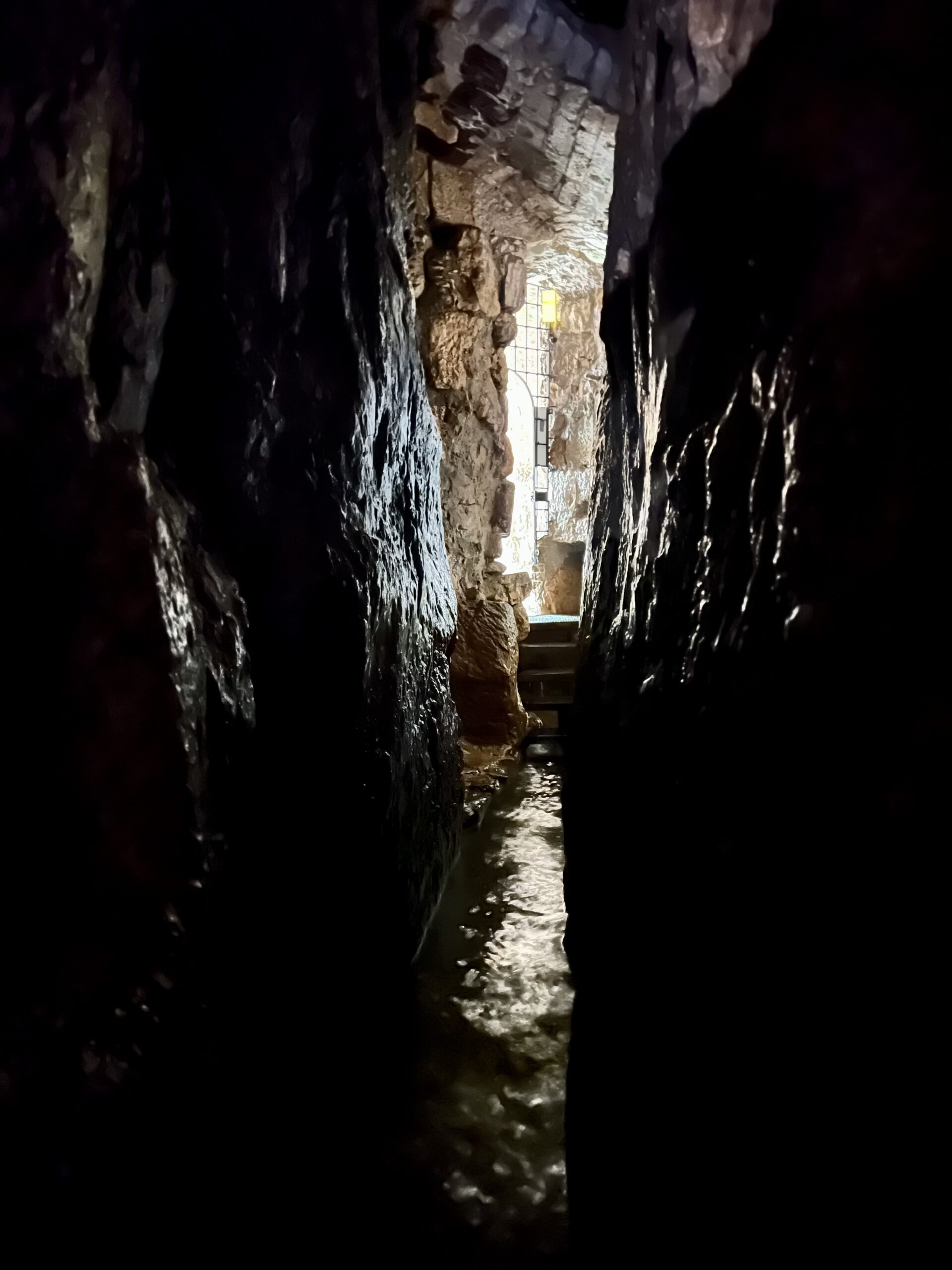
Probably because I recently walked through it in shin deep water in the dark!
4: Siloam Tunnel/Hezekiah’s tunnel
2 Kings 20:20
20 As for the other events of Hezekiah’s reign, all his achievements and how he made the pool and the tunnel by which he brought water into the city, are they not written in the book of the annals of the kings of Judah?
2 Chronicles 32:30
30 It was Hezekiah who blocked the upper outlet of the Gihon spring and channeled the water down to the west side of the City of David. He succeeded in everything he undertook.
Before I turn this over to you, Karl, Hezekiah was a good king, son of King Ahaz, of the Kingdom of Judah. King Ahaz assimilated to the pagan culture and sacrificed Hezekiah’s brother. Hezekiah was a follower of God, purified the temple after his dad defiled it, destroyed the idols of the land, and ruled for 29 years. He also reinstated the celebration of Passover.
Karl, it’s yours now –
Siloam Tunnel / Inscription
“The Siloam Tunnel, also known as Hezekiah’s Tunnel is a tunnel that was carved within the city of David in ancient times, now located in southeast Jerusalem. Its popular name is due to the most common hypothesis that it dates from the reign of Hezekiah of Judah, late 8th and early 7th century BC, and corresponds to the “conduit” mentioned in 2 Kings 20 in the Old Testament. According to the Bible, King Hezekiah prepared Jerusalem for an impending siege by the Assyrians, by,
“…blocking the source of the waters of the upper Gihon, and leading them straight down on the west to the City of David” (2 Chronicles 32:30). By diverting the waters of the Gihon, he prevented the enemy forces under Sennacherib from having access to water.”
Discovery
The Siloam tunnel was discovered in 1838 by Edward Robinson. The tunnel was studied extensively by numerous archeologists in the 19th century, including most famously Charles Wilson and Charles Warren. Everyone missed the inscription, most likely due to the accumulated mineral deposits that concealed the words, making it hidden from view.
The idea of dating the tunnel to Hezekiah’s period was derived from the Biblical text that describes construction of a water tunnel in his time. Scientific support for this, however, came from radiocarbon dates of organic matter contained in the original plastering and confirmed in 2011by more specific radiometry dating.
According to Aharon Horovitz, director of the Megalim Institute (Multidisciplinary learning and research center in Jerusalem), the tunnel can be interpreted as,
“… an additional aqueduct designed for keeping the entire outflow of the spring inside the walled area, which included the downstream Pool of Siloam, with the specific purpose of withholding water from any besieging forces. Both the spring itself, and the pool at the end of the tunnel, would have been used by the inhabitants as water sources. Troops positioned outside the walls wouldn’t have reached any of it, because even the overflow water released from the Pool of Siloam would have fully disappeared into a karstic system located right outside the southern tip of the city walls. In contrast to that, the previous water system did release all the water not used by the city population into the Kidron Valley to the east, where besieging troops could have taken advantage of it” (cave, spring, sinkhole, etc. caused by water dissolving carbonite rocks).
The curving tunnel is 583 yards (533 m; about 1⁄3 mile) long and by using the 12 inch (30 cm) altitude difference between its two ends, which corresponds to a 0.06 percent gradient, the engineers managed to convey the water from the spring to the pool.
According to the Siloam inscription, the tunnel was carved out of the living rock by two teams, one starting at each end of the tunnel and then meeting in the middle. The inscription is partly unreadable at present and may originally have conveyed more information than this. It is clear from the tunnel itself that several directional errors were made during its construction. How the Israelites dealt with the difficult feat of making two teams digging from opposite ends meet far underground is still not fully understood, but some suggest that the two teams were directed from above by sound signals generated by hammering on the solid rock through which the tunnelers were digging.
Discovery and interpretation
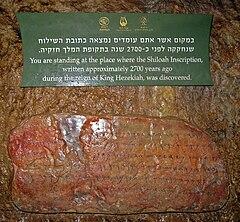
A copy of the Siloam inscription in its original location inside Hezekiah’s Tunnel, 2010
in 1871 Warren suggested that the Pool of Siloam may have been “dug by King Hezekiah” and in 1884 following the discovery of the Siloam inscription wrote that:
“The inscription thus appears to belong to the later period of the Hebrew monarchy and may very well be considered to agree with the Biblical account of Hezekiah’s preparations for Sennacherib’s siege.”
The Siloam Inscription reads:
Behold the tunnel. Now this is the matter of the tunnel. While the stone-cutters were lifting the axe one man towards his neighbor, and while there remained three cubits to be cut, the voice of a man could be heard calling out to his neighbor, for there had been [only] its side deviation in the rock-face [where they were supposed to meet up], on the right and on the left, and on the day when the tunnel was being cut out, the stone-cutters struck each man in front of his neighbor, axe against axe and the waters from the source flowed into the pool for [a distance of] 1,200 cubits. Now one-hundred cubits was the height over the head of the stonecutters.
We first hear of cubits in the Noah story in Genesis 6. It is the measurement of a person’s middle fingertip to his/her elbow.
The inscription hence records the construction of the tunnel; according to the text the work began at both ends simultaneously and proceeded until the stonecutters met in the middle. (100 cubits is about 172 feet)!
Function and origin
We have been to the ancient city of David by Jerusalem, and seen some of the natural defenses, but a problem has to do with the city’s source of fresh water (The Gihon Spring), which is located in the Kidron valley, just outside the old city walls. It’s still a functioning water source today. But this was a major weakness in the defense of the city against attackers because of its location.
Biblical interpretation
2 Chronicles 32:2-4
When Hezekiah saw that Sennacherib had come and that he intended to wage war against Jerusalem, he consulted with his officials and military staff about blocking off the water from the springs outside the city, and they helped him. They gathered a large group of people who blocked all the springs and the stream that flowed through the land. ‘Why should the kings of Assyria come and find plenty of water?’ they said.
Isaiah 22:11
You also saw the City of David, that it was great; And you gathered together the waters of the lower pool. You also made a reservoir between the two walls for the water of the old pool. But you did not look to its Maker, Nor did you have respect for him who fashioned it long ago.
John 9
As he went along, he saw a man blind from birth. 2 His disciples asked him, “Rabbi, who sinned, this man or his parents, that he was born blind?”
3 “Neither this man nor his parents sinned,” said Jesus, “but this happened so that the works of God might be displayed in him. 4 As long as it is day, we must do the works of him who sent me. Night is coming, when no one can work. 5 While I am in the world, I am the light of the world.”
6 After saying this, he spit on the ground, made some mud with the saliva, and put it on the man’s eyes. 7 “Go,” he told him, “wash in the Pool of Siloam” (this word means “Sent”). So the man went and washed, and came home seeing.
The inscription is on exhibition at the Istanbul Archaeology Museum, one of three ancient inscriptions from the region held by the museum (the other two being the Gezer calendar and the Temple Warning inscription). A replica is on display at the Israel Museum. Turkey has refused Israel’s request to be sent the Siloam inscription, and other artifacts unearthed during Ottoman Palestine rule and transferred to Turkey.
References:
- “Siloam Inscription”. Jewish Encyclopedia. 1906.
- “THE ANCIENT HEBREW INSCRIPTION OF SILOAM.” 1888.
- Rendsburg, Gary; Schniedewind, William (2010). “The Siloam Tunnel Inscription: Historical and Linguistic Perspectives.” Israel Exploration Journal. Retrieved 2015-05-02.
- “What is Karst?” Environmental Science Institute. The University of Texas at Austin. 16 May 2006. Retrieved 25 December 2020.
________________________________________
Let’s summarize our 4 biblical evidences:
- Pilate Stone: We have proof that Pontius Pilate lived in Caesarea Maritima (there were 2 Caesarea- the other is Phillippi, in the north of Israel, the territory of Dan).
- Pilate coins minted in Jerusalem.
- Naboth’s vineyard: Proves that it was not only there but Ahab and Jezebel never got their garden planted!
- Tel Dan Stele:
- Hezekiah’s tunnel: dating and inscriptions bringing it back to King Hezekiah during his reign beginning in 715 BC.
________________________________________________________________________________
Wow, that was so much information!
Thank you for digging and sharing with us!!
Shalom my friends. I look forward to the next time!
**Heather!
©2025 Heather M R Olsen, Illumination: Hebrew Insights. All rights reserved.

