

Program Transcript
Episode 42: Dig a Little Deeper: Give Generously
Heather M R Olsen
Welcome back to Illumination.
As always, I’m delighted and grateful that you have tuned in. There is so much to learn in the Bible and God uses His Words in the Bible to speak to us. Thank you for tuning in to hear what He has to say about giving.
This time of year at our churches or houses of worship, we often have a money sermon. You know…Giving. Tithing. Stewardship.
The annual budget needs to be planned and we are challenged to dig deep and trust deeper!
This call to give generously is not from our leftovers,
Or because we are afraid we won’t receive God’s favor,
But out of a deep trust in the God who has already given us everything… the life of His only son, Jesus, who gave us life.
Biblical history of giving a 10th can be first found in,
Genesis 14:18-20
Then Melchizedek king of Salem brought out bread and wine. He was priest of God Most High, 19 and he blessed Abram, saying,
“Blessed be Abram by God Most High,
Creator of heaven and earth.
20 And praise be to God Most High,
who delivered your enemies into your hand.”
Then Abram gave him a tenth of everything.
Significant points in this passage:
- Melchizedek: His Name = King of Righteousness
- He’s from Salem: a city that’s precursor to Jerusalem [“Yireh” or “yir” = city , “Shalom/shalem” = peace]
- He brought and gave to Abram bread and wine!
- Melchizedek blessed ABRAM!
- He was a priest of the most High God
- In fact, this non-Levitical priest was a priest of the Most High God prior to Abraham being called out by God.
- Abram gave him a 10th of everything.
Let’s read a bit more about Abram and Melchizidek in,
Melchizedek the Priest
This Melchizedek was king of Salem and priest of God Most High. He met Abraham returning from the defeat of the kings and blessed him, and Abraham gave him a tenth of everything. First, the name Melchizedek means “king of righteousness”; then also, “king of Salem” means “king of peace.” Without father or mother, without genealogy, without beginning of days or end of life, resembling the Son of God, he remains a priest forever.
4 Just think how great he was: Even the patriarch Abraham gave him a tenth of the plunder! 5 Now the law requires the descendants of Levi who become priests to collect a tenth from the people—that is, from their fellow Israelites—even though they also are descended from Abraham. 6 This man, however, did not trace his descent from Levi, yet he collected a tenth from Abraham and blessed him who had the promises. 7 And without doubt the lesser is blessed by the greater. 8 In the one case, the tenth is collected by people who die; but in the other case, by him who is declared to be living. 9 One might even say that Levi, who collects the tenth, paid the tenth through Abraham, 10 because when Melchizedek met Abraham, Levi was still in the body of his ancestor.
It’s a bit of cyclical thinking. Reminds me of a philosophy class I took in college—logic. I lasted 3 weeks then dropped it. The cyclical thinking made my brain bend.
But here both men are the greaters; Melchizedek, the king and priest, blessed Abram, the Father of God’s people, the great patriarch.
But tithing officially was named during Moses’ time (Leviticus 27).
God gave instructions to the Israelites through Moses that 1/10th of what they owned was to be given back to Him.
Some of this was food for the Levites who were not allowed to own property as their inheritance was from the LORD.
Other parts of the tithes were to support /upkeep the tabernacle or the temple, to pay for ongoing sacrifices, etc.
Fast forward when the Jewish people were in captivity or exile among the Babylonians.
The Medes-Persians defeated Babylon in 539 BC, then Persian King Cyrus began to release the Jewish people in three waves back to Jerusalem to rebuild their city and temple.
Zerubbabel led the first and largest group back, and he spearheaded the rebuilding of the temple. He was followed decades later by Ezra then Nehemiah.
Malachi, the prophet and namesake of the last book of the Old Testament, became a prophet in 430 BC, around 138 years after the first Jews returned to the land.
As a prophet, Malachi’s job was to keep teaching and refining the returned Jewish people. They had done so many things that had turned from God.
Let’s read,
Malachi 3:8-10
“Will a mere mortal rob God? Yet you rob me.
“But you ask, ‘How are we robbing you?’
“In tithes and offerings. 9 You are under a curse—your whole nation—because you are robbing me. 10 Bring the whole tithe into the storehouse, that there may be food in my house. Test me in this,” says the Lord Almighty, “and see if I will not throw open the floodgates of heaven and pour out so much blessing that there will not be room enough to store it.”
This is relevant to each of us as well.
God promises floodgates of blessings with not enough room to store!
Before we unpack that statement, let’s move to one of Jesus’ teachings.
Luke 21:1-4
The Widow’s Offering NIV
21 As Jesus looked up, he saw the rich putting their gifts into the temple treasury. 2 He also saw a poor widow put in two very small copper coins. 3 “Truly I tell you,” he said, “this poor widow has put in more than all the others. 4 All these people gave their gifts out of their wealth; but she out of her poverty put in all she had to live on.”
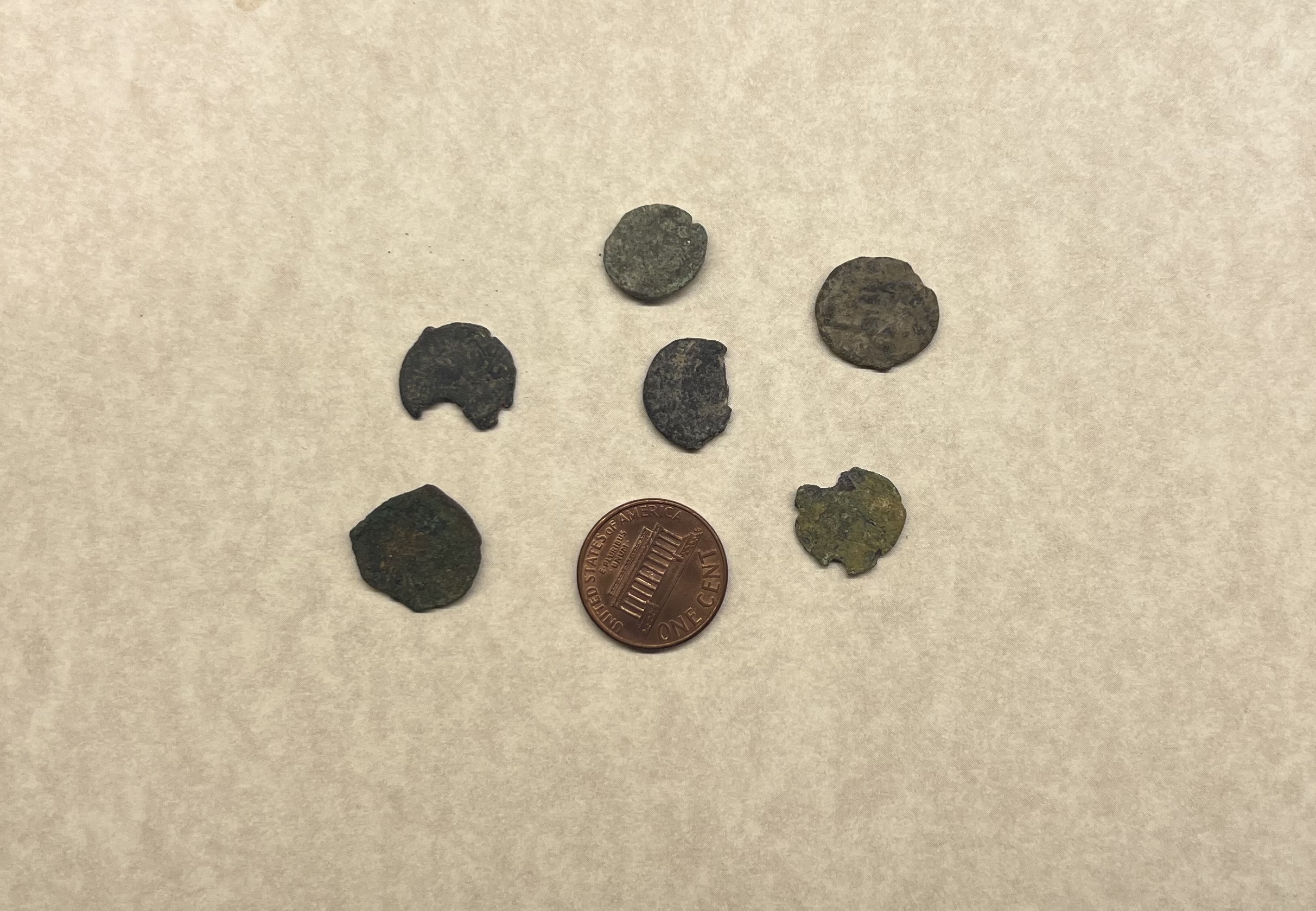
In the KJV and NKJ version, these 2 coppers coins are translated as mites. You may have heard of the Widow’s Mite; that references this narrative in the Bible.
A mite is not necessarily an accurate translation but rather a translation used by King James’ Bible translators to replace the original Greek word, lepton. It was chosen so the readers in England at the time could understand the meaning of this very miniscule bit of money.
The original Hebrew coin was much smaller and less valuable than an English mite, but the translation made the lesson about sacrificing what little she had more relatable to the people of the time.
The actual Greek word is “lepta” meaning “fine, thin, small, light.”
From Strong’s concordance, I read that,
“A lepton was the thinnest, lightest Judean bronze coin in circulation during the Second Temple era. Two leptons =1/128 of a denarius—the denarius being the daily wage of a laborer.”
Let’s say one made $20/hour which would be $160/day. This 1/128th of money would be $1.25 if I did my math correctly.
Her 2 lepton was tangible evidence of her supreme poverty.
Back to Strong’s concordance,
“The lepton (or mite) therefore becomes a symbol of sacrificial faith, demonstrating that divine evaluation hinges on the heart, not on the face value of the gift.”
This story:
You know the SIGNIFICANCE.
Jesus’ admonition redefines generosity as coming not from wealth but the sacrifice and trust behind the gift. It’s about the condition of our hearts.
With Jesus, it’s always about the condition of our hearts.
In my “Speaking Our Hearts: Good Fruit or Bad,” I referenced Adele Ahlberg Calhoun’s
“Spiritual Disciplines Handbook.”
Her subtitle is, “Practices that Transform Us”
By watching what we say or learning to give generously, we are continuing in the sanctification process: becoming more like Jesus.
Giving generously is a practice that transforms us.
Calhoun calls this spiritual discipline stewardship. She pins down that “awareness that nothing I have is my own.”
I’m standing here. My computer, my phone, my clothes, my brain, and how it works. Not my own. My house, my Bible, my car. Nothing.
Calhoun defines stewardship as the “voluntary and generous offering of God’s gifts of resources, time, talents, and treasure for the benefit and love of God and others.” None of these items are our own.
Remember: what we say defines what is in our hearts.
But also, what and how we give defines what is in our hearts.
We need to live in a way that exemplifies that our lives, time, money, home, family are all God’s.
Deuteronomy 8:17-18
17 You may say to yourself, “My power and the strength of my hands have produced this wealth for me.” 18 But remember the Lord your God, for it is he who gives you the ability to produce wealth, and so confirms his covenant, which he swore to your ancestors, as it is today.
In this passage, God was telling it to the Israelites as well.
Greed, self-sufficiency, and idolatry are age old human problems!
As believers, sharing should be in our DNA.
Some Christian leaders have dubbed our consumerism as “Affluenza.”
As the Body of Christ, how can we get vaccinated against “Affluenza?”
Are we building God’s kingdom or our own?
Psalm 24:1
King David
1 The earth is the Lord’s, and everything in it, the world, and all who live in it;
Everything!
What are some ways we can vaccinate?
- Gifts of hospitality—especially to those who are in need
- Recently I had back surgery. Meals, texts, friends came over to walk with me, flowers, etc.
- Modeling God’s goodness and generosity
- How you give/donate—church, food bank, clothing, furniture
- Self-aware when we are self-focused or lack love of others.
- Calling ourselves out!
- Taking care of the earth as a gift from God.
- Church doesn’t finance itself.
- Staff salaries, programs, outreach, building, heat, mowing. Our church has invested in security cameras and a [volunteer] security team.
God had a cool story recorded in Exodus. It was during the building of the tabernacle. Moses had asked the people to give their talents (builders, metalsmiths, goldsmiths, carvers, textile weavers), their gold and their time.
The Israelites were so excited!
Exodus 36:3-7
3They [the builders] received from Moses all the offerings the Israelites had brought to carry out the work of constructing the sanctuary. And the people continued to bring freewill offerings morning after morning. 4 So all the skilled workers who were doing all the work on the sanctuary left what they were doing 5 and said to Moses, “The people are bringing more than enough for doing the work the Lord commanded to be done.”
6 Then Moses gave an order and they sent this word throughout the camp: “No man or woman is to make anything else as an offering for the sanctuary.” And so the people were restrained from bringing more, 7 because what they already had was more than enough to do all the work.
Moses had to tell the people to STOP bringing donations!
Can you imagine if your Pastor said that to your congregation?
“You have given too much! We can’t use all of your resources, time or money! STOP! We have too many ushers. Too many singers. Too many cleaners. Too many bakers. Stop!”
That has never happened in my lifetime.
Nobody wants to have money conversations.
But let’s you and I be convicted: What is in our hearts?
We aren’t looking at others and what we think is in their hearts.
Let’s examine our own. Period.
If God asked each of us, “Are you doing all you can with what I have given you?”
How would we each answer Him?
No guilt.
Just joy.
Gratitude.
In Judaism there is a tzedakah box (Hebrew: קוּפָּת צְדָקָה ). This is a receptacle for charitable donations.
(Tzedek = justice or righteous)
This Tzedakah Box can be in the home or synagogue. Money is put in for charitable causes and the poor. When the box is full, the donation is distributed.
2 Corinthians 9:6-7
Generosity Encouraged
6 Remember this: Whoever sows sparingly will also reap sparingly, and whoever sows generously will also reap generously. 7 Each of you should give what you have decided in your heart to give, not reluctantly or under compulsion, for God loves a cheerful giver.
As a child, I watched as my dad transformed in this sense. As he aged, he found great delight in giving to the LORD.
In his younger years, he held onto their money with white knuckles (this is what little Heather observed). My mom patiently encouraged him to give more. And then more.
Money is a fickle thing. And we can get really attached.
My dad found great joy in giving to those in need.
In giving to organizations that help those in need.
He was on the journey.
Sanctification.
Becoming more like Jesus.
Who gave His life willingly for each of us.
For every person in the world.
Jesus encourages and admonishes in,
Matthew 6:19-20
Treasures in Heaven
19 “Do not store up for yourselves treasures on earth, where moths and vermin destroy, and where thieves break in and steal. 20 But store up for yourselves treasures in heaven, where moths and vermin do not destroy, and where thieves do not break in and steal.
Pray about what God is teaching you about storing up treasures in Heaven.
We named some tangible ways earlier.
- Hospitality to those in need.
- Caring for the earth.
- Money to food banks or organizations that help others.
- Donations to your place of worship.
- And self-checking when we get out of whack
Let’s go back to,
Malachi 3:10
Test me in this,” says the Lord Almighty, “and see if I will not throw open the floodgates of heaven and pour out so much blessing that there will not be room enough to store it.”
Luke 6:38
38 Give, and it will be given to you. A good measure, pressed down, shaken together and running over, will be poured into your lap. For with the measure you use, it will be measured to you.”
Philippians 4:19
19 And my God will meet all your needs according to the riches of his glory in Christ Jesus.
Those verses are barely getting us started with God’s promises of blessings.
Let’s quick pause on God’s blessings.
These blessings could be instantaneous. They could be a light and joyous heart.
They also, though, could be delayed.
I will never teach a prosperity gospel that promises that the more you give, the more you will get.
God will not be manipulated.
Remember Jesus’ words in John 16:33
“I have told you these things, so that in me you may have peace. In this world you will have trouble. But take heart! I have overcome the world.”
Each of us as believers ultimately have the greatest treasure of blessings when we meet Jesus. Eternity with him.
Perfection and a forever existence of all good.
Pray about how we each can improve our stewardship!
It’s personal so don’t look at others.
Let’s vaccinate against “affluenza” by giving lavishly!
See what great love the Father has lavished on us, that we should be called children of God!
Let’s lavish because He lavished.
God’s Promises are secure. And True. He will not break them. Ever.
Go through the entire Bible.
Let us hold unswervingly to the hope we profess, for he who promised is faithful.
Shalom Friends –
**Heather!
©2025 Heather M R Olsen, Illumination: Hebrew Insights. All rights reserved.

