

Program Transcript
Episode 43: Waiting and Watching: Advent
Heather M R Olsen
Welcome to Illumination, Friends.
I’m always delighted to have you here as we dig into biblical history, translational nuances, and truths in the Bible.
Today we are going to explore the season of Advent.
Many churches celebrate—what Little Heather deemed to be—the countdown to Christmas. In fact, as a child, Advent made waiting for Christmas excruciating because I was hyper-aware of the time between the present and the presents!
Some denominations or seekers or new believers do not know what Advent is. Even some seasoned believers don’t know the history, so here is a quick explanation and recap.
The western/Roman world added the Advent season to the calendar, dubbing it the first season of the church year by the beginning of the 8th century. The focus being on hope for Jesus’ renewal in believers’ lives, His presence, and preparation to welcome Him into the world.
I mentioned Advent is a time of waiting, preparation, and hope but true hope can only be found in the Incarnation. The greatly celebrated holiday of Christmas is frenzied and chaotic as we often get lost in consumerism and parties and details and food while we forget the real Reason for the Season. It’s during this time of Advent that we as believers are called to slow down and reflect on the arriving Christ child. We are to experience Jesus born in us, either for the first time, or a renewal.
Rewind deep into history, around 586 BC, as the Jewish people were taken into Babylonian captivity. God had sent His Teachings and Instructions to the Israelites through the Torah to guide the people. They didn’t cooperate. He sent judges and prophets to guide the people. That didn’t work. Compromise with the world and assimilating into outlying pagan communities was just too appealing. God had repeatedly told His people of the consequences of their sins of compromise and idolatry. Finally, they were taken out of the Land into captivity by the Babylonians under King Nebuchadnezzar.
70 years later, after the Medes-Persians conquered Babylon, exactly when God had prophesied: when the 70 years were complete, the Jewish people would be allowed to return to the Land. These Jewish people knew waiting and watching and longing. They had waited a long time for deliverance.
Fast forward to the first century. The Land had been battled over by the various groups of Greeks, then political Jewish rulers, and, by the time Jesus arrived, the Romans. The Jewish people were still waiting for deliverance. We can read in Luke 2:25, about a righteous and devout man, Simeon who had been waiting for the consolation of Israel.
Upon meeting baby Jesus, Simeon declared that his eyes “have seen your salvation, which you have prepared in the sight of all nations: a light for revelation to the Gentiles, and the glory of your people Israel.”
The consolation of Israel, and light for the Gentiles had arrived in this baby who was the Messiah. The Advent carol, O Come O Come Immanuel gives credence to this history of God’s people watching and waiting for the Messiah. And Immanuel arrived; “God With Us” came.
This carol was originally written in Latin and has been around over 1,200 years. Let’s take a moment to reflect on the lyrics:
O come, O come, Immanuel,
and ransom captive Israel
that mourns in lonely exile here until the Son of God appear.
Refrain:
Rejoice! Rejoice! Immanuel shall come to you, O Israel.
O come, O Wisdom from on high,
who ordered all things mightily;
to us the path of knowledge show
and teach us in its ways to go.
O come, O come, great Lord of might,
who to your tribes on Sinai’s height
in ancient times did give the law
in cloud and majesty and awe.
O come, O Branch of Jesse’s stem,
unto your own and rescue them!
From depths of hell your people save,
and give them victory over the grave.
O come, O Key of David, come
and open wide our heavenly home.
Make safe for us the heavenward road
and bar the way to death’s abode.
O come, O Bright and Morning Star,
and bring us comfort from afar!
Dispel the shadows of the night
and turn our darkness into light.
O come, O King of nations, bind
in one the hearts of all mankind.
Bid all our sad divisions cease
and be yourself our King of Peace.
Rejoice! Rejoice! Immanuel shall come to you, O Israel.
Historically written and hauntingly composed, this carol epitomizes God’s people imploring a rescue that only “God With Us” could accomplish.
One of my sons recently asked why Advent hymns and many Christmas ones are somber. He told me little Garrett wanted to ask but thought it would be perceived as irreverent. Often as church goers we simply accept what is presented. Advent hymns are written in minor keys and now we are learning, rather than initially celebrating the upcoming joy during Advent, the mood is penitential, introspective and reflective.
Expressions of cheer will come soon!
The Advent season begins 4 Sundays prior to December 25th, often, the Sunday of Thanksgiving weekend. In 2025, this is the case.
Early observances began in Gaul and parts of Spain. The focus was 1.) preparing hearts for the birth and, surprisingly, 2.) looking with anticipation to Jesus’ Second coming, when He will rule earth in perfection and harmony.
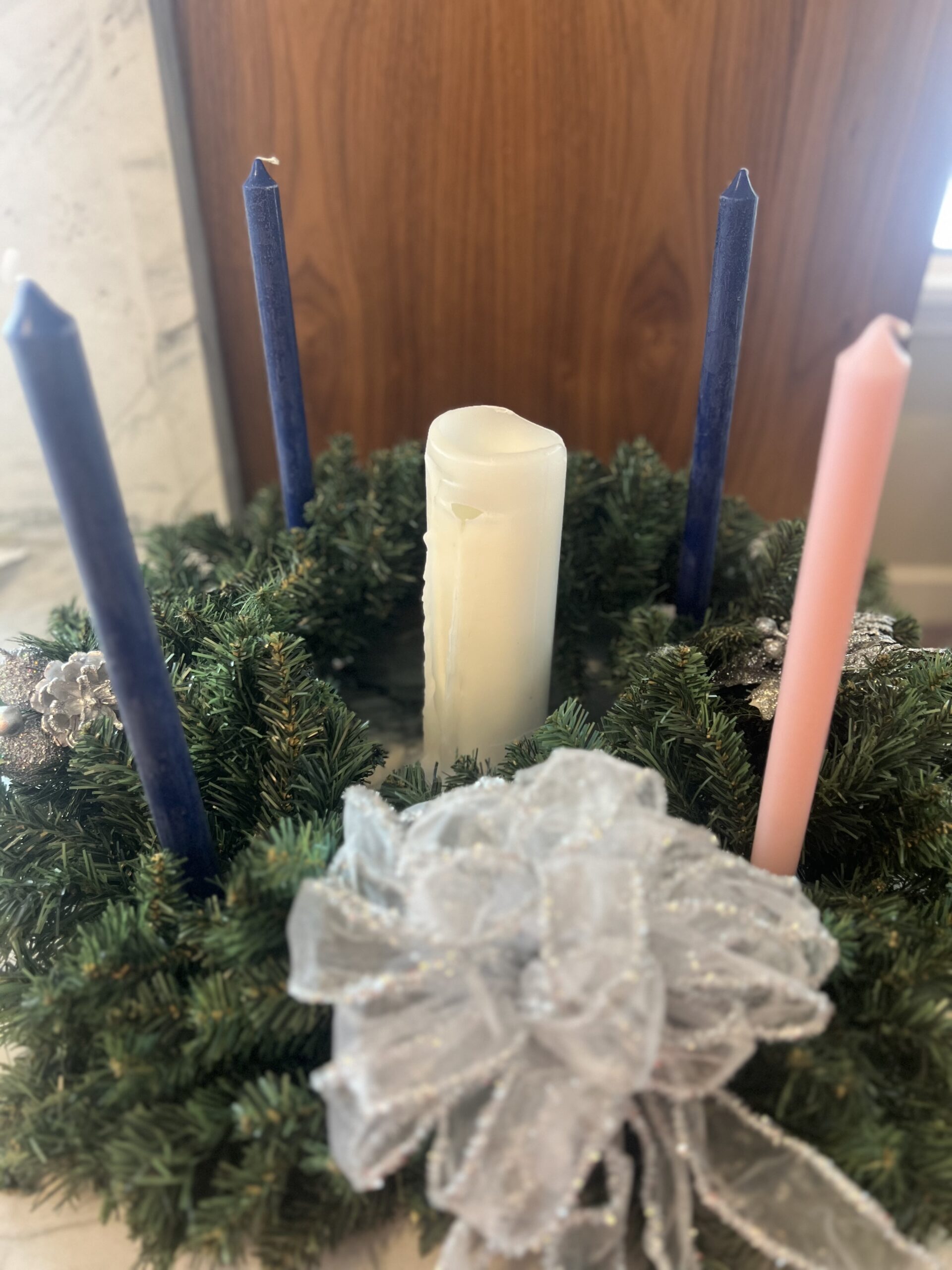
The word Advent or “aventus” is Latin which means “arrival.” This seasonal tradition emerged in western European Christian communities in the fourth century. Beginning in the 4th century, there were varying regional differences which converged into a standardized tradition during the Middle Ages, which more closely linked the season to the Christmas story. The tradition of the advent wreath emerged out of pagan practices. Each year, as fall faded into winter, Christians in northern Europe began lighting a candled wreath. This candled wreath became a symbolic resistance against the shorter days and more prevalent darkness of winter. “Pre-Christian Germanic and Scandinavian people mounted candles on evergreen wreaths or wooden wheels to implore their gods to turn the dark season back to a time of warmth and light. As northern Europeans became Christians, many of their prior traditions took on new meanings.”This adaptation is similar to Emperor Constantine repurposing a pagan Roman holiday on December 25th into celebrating the birthday of Jesus. Soon, Germanic and Scandinavian Christians adapted the candled wreath to point to Jesus’ power over darkness in our lives. Not until 1839 that a German Lutheran pastor and missionary created the contemporary Advent wreath, with a set number of candles lit each week to count down until the Christ mass. |
Today, religiously, Advent is observed often with midweek church services as well as on Sunday. Advent candles on this wreath are lit, one each Sunday, and are associated with spiritual virtues like hope, peace, joy, and love.
Moving past religious observance, the modern season is defined by Advent calendars, often mass-marketed as a countdown to the days before Christmas. My mom made an Advent strip of felt that we kids hung in our rooms. This strip of felt had a piece of candy tied on for each day between December 1–24. In the past, I have purchased Advent countdowns for my children that have 24 doors that lead to a small piece of chocolate.
We also have an Advent calendar of 24 mini books piecing together the story of The Gift of the Magi, a beautiful narrative about self-sacrifice and love. Daily, each little book is removed from the stand, read, and hung on a little tree.
Advent commercialism has also developed into alcohol advent calendars, as well as various toy calendars.
Back to church tradition, in my own church, the advent candles again represent 4 Christian virtues: Hope, Peace, Joy, & Love, with a fifth candle in the center, named the Christ candle. This Christ candle is lit on Christmas day to signify Jesus’ birth. Even the colors of the candles are significant: three are purple or blue for repentance and hope, one is pink for joy and the Christ candle white. The third week, pink for joy or “Guadate,” [gow-deh-teh] “rejoice,” in Latin, finally lightens the somber mood of Advent.
Prior to Jesus’ ministry, John the Baptist was sent to prepare the way for the Messiah and prepare the hearts of the people. John fulfilled Isaiah 40:3’s prophecy as “A voice of one calling in the wilderness “prepare the way for the Lord; make straight in the desert, a highway for our God.
John went into all the country around the Jordan, preaching a baptism of repentance for the forgiveness of sins. Luke 3:3
Advent does just this for us as well. It prepares our hearts for the coming King, God’s perfect and free gift of salvation for all who receive Him. The season is meant to be a focus of our minds and hearts on God’s promises of a Savior, Redeemer, Great Deliverer, and Consolation.
How do we receive this Gift?
By humbly repenting and confessing our sins. Pray longingly for salvation—Jesus’ salvation. Jesus’ name means “Salvation” or “Salvation from God” because He would save us from our sins. God’s choice of names was not coincidental.
God has put in every heart a desire to know Him and to know that this place, earth, isn’t all there is.
Back to history: Advent officially began as a church tradition in the 4th century at a similar time that Christmas was adopted to December 25th. This December 25th holiday was an anchored holiday rather than the moving Easter and Pentecost dates. Typically, in the early church, Christmas, Easter, and Pentecost hosted baptisms of new believers. Some church members would pray and fast as the new believers received instructions prior to their baptism. This spiritual preparation lasted 3-6 weeks. Sound familiar?
This theme of spiritual readiness began to incorporate Jesus’ Second Coming as well. The triumphant Messiah!
Author Michelle Van Loon in her book, Moments and Days, reminds us that rather than adding more to our season, we should “subtract or minimize” to make our focus more meaningful. Choose to do less. Contemplate what matters most in life!
- Immanuel. God with Us.
- The Son of God.
- The Son of Man.
- The Word became flesh who dwelt among us.
- God came Down
- The Bread of Life.
- The Light of the World.
- The Rising Sun.
- The Faithful and True Witness.
- Ruler of God’s Creation.
- Lord of Lords.
- Name above all names,
- The Amen.
- The King of Kings.
- Sar Shalom, the Prince of Peace.
- Yeshua. Salvation.
- The Messiah, the anointed One.
All Names for Jesus.
Friends. Take time this season and prepare your hearts.
Let me close with lyrics of another beautiful and somber carol:
Come, thou long expected Jesus,
born to set thy people free;
from our fears and sins release us,
let us find our rest in thee.
Israel’s strength and consolation,
hope of all the earth thou art;
dear desire of every nation,
joy of every longing heart.
Born thy people to deliver,
born a child and yet a King,
born to reign in us forever,
now thy gracious kingdom bring.
By thine own eternal spirit
rule in all our hearts alone;
by thine all sufficient merit,
raise us to thy glorious throne.
I will personally be reading the Gospel of Luke this advent season. There are 24 chapters, so my plan is to read one chapter each day as my personal Advent calendar.
Please join me in this reverential activity.
Friends, the Messiah has come. God’s promises of old always come to pass.
Luke 1:37 For no word from God will ever fail.
Prepare your hearts now!
Shalom –
**Heather!
©2025 Heather M R Olsen, Illumination: Hebrew Insights. All rights reserved.

