

Program Transcript
Episode 45: Names of God: Almighty (Shaddai)
Heather M R Olsen

Shalom Friends – Chaverim.
Thank you for listening.
Illumination is a nonprofit, set aside to illuminate truths in the Bible. The overarching goal is to entice believers to read the Bible, which is a very exciting book, and for unbelievers to dig and discover that the Bible is true and relevant and that Jesus died for all, believers and unbelievers.
Listeners, Jesus is the lynchpin of the Chrisitan faith and wants all to come to Him.
A girlfriend recently challenged me to do a monthly series on names of God. Short, hopefully sweet, but some points to get you thinking about God and His many facets, names, and descriptors, all found within the pages of your Bibles.
I often think of a human personality as a prism. You may only get to see a couple sides of someone’s prism. A good friend would get to see several sides and a multitude of reflections. Karl, in my life, gets the whole spinning kit and kaboodle—good, bad, and ugly. Some days, I think it’s a miracle he wants to be by my side. I’m human and don’t always love it.
But God—can we refer to God as a Prism?
Can we truly see all His facets or understand Him or fully know Him?
Could anyone see His infinite and eternal qualities?
We often approach other people through our own lenses; we interpret words and actions based on our own experiences.
But how or why does an individual behave the way they do? What is the purpose for one’s words or actions?
If we truly knew someone’s history and experiences, we would better accept one another in a more empathetic and sympathetic way. But we can only know the facts of what each person reveals to us.
We often try to approach God the same way: from our own lenses. For example, if we had an untrustworthy earthly father, or one who was abusive, why would we believe that there is an all powerful, fully trustworthy God?
Periodically, I get asked by an unbeliever or in reference to an unbeliever, “Why would a Good God let _____ happen?”
You fill in the blank.
A Tornado. Tsunami. A young mom dying in a car accident. A child dying from cancer.
Why is there disease, dementia, hate, terrorism, rape, murder?
The list is infinite.
I’ll unravel this topic more fully in a later podcast, soon, but let’s get our brains moving.
I often call that question about God, Atheist or Agnostic 101. It’s a conversation stopper for the unseasoned Christian because it’s so difficult to answer. There isn’t a quick response, but rather it is a sit-down dialogue over a cup of coffee that could last the afternoon.
We approach The God of the Universe through our own lenses as though He were as finite and flawed as each of us. Many claim Him as one’s own but deny Him when crushed by the weight of this world.
So, let’s double down and explore.
Of course, our only reliable source is the Bible, God’s Words to humanity.
When we don’t understand what is happening in this world and “Why would God…”, first, we need to reset our view of God.
- God is not human.
- God is not fallible; he doesn’t make mistakes.
- God’s character does not sway like the world’s, like shifting sands.
- He is unchangeable, immutable.
- He is the three omni’s: omnipotent, all powerful; omniscient, knows all; omnipresent, God is everywhere.
- In the Bible, God describes Himself with the attribute: Chesed. Chesed is a Hebrew word and a covenantal term illustrating God’s covenantal character. This word, Chesed, encompasses all the positive attributes of God, a means to help us understand His beautiful character. The definition is more of a paragraph rather than a synonym.
- Abounding in steadfast love, merciful, benevolent, charitable, kind, compassionate, full of grace, loving kindness, faithful, steadfast, abundant goodness, loyal, everlasting and enduring commitment, promise keeper, unyielding, patient, so much deep, truly loyal love.
- This multitude of character traits are summed up in the word Chesed.
- God is genderless – God made man and woman in His own image. (Genesis 1:27)
If you haven’t listened to Illumination’s 3rd podcast, “Elohim (יהוה)”, it will lay some groundwork on God and His immutable, for-all-of time-and-space, forever Name…
In the church we say, YHWH, but in reality, we don’t know the vowels. I prefer to spell God’s name with the Hebrew letters, yod–heh–vav–heh.
YHVH: the only name I know that is a verb because God does the doing in this world and in our lives.
God reminded Moses in Exodus 3 who He is.
אֶֽהְיֶ֖ה אֲשֶׁ֣ר אֶֽהְיֶ֖ה
“I am who I am.” “I am.” God is Always… God was, is, will be. Eternally. Forever.
For today, let’s double down on a Name and Attribute of His: Almighty.
Or in Hebrew, שַׁדַּי Shaddai.
Of course I start with Merriam-Webster, a dictionary that has preserved traditional religious definitions.
Almighty is “having absolute power overall.”
The Hebrew “Almighty” or “Shaddai” is in a popular Amy Grant song from the 80’s, El Shaddai.
I remember doing interpretative dance to this song when I was a camp counsellor back in MN.
I can’t hear the song without my arms swinging and myself spinning and dancing.
We’ve learned that El tacked onto an adjective is short for “God” so El Shaddai is God Almighty.
In a quick search, I found Almighty 333 times in the NIV Bible. Many are El Shaddai, others are יהוה Shaddai, and yet others are simply HaShaddai, the Almighty, turned into a noun.
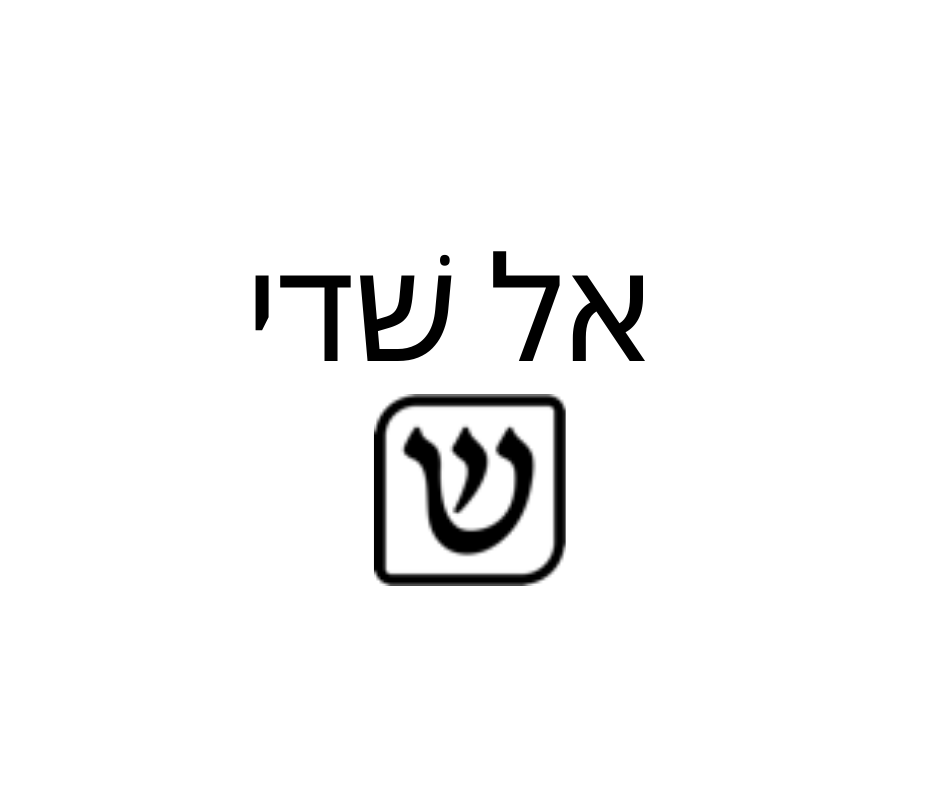
If you haven’t listened to my podcast, “The Hebrew Letter ‘Shin’”, please take a moment. The Hebrew letter shin looks like an English double-u, and is found on many Jewish items, such as the mezuzah, tefillin (phylacteries in Yiddish), and dreidels. My logo, in orange on the podcast, is the letter shin. Shin stands for Shaddai in Hebrew, a reminder of God Almighty.
If we break down almighty [one word] to All Mighty [two words], “might” means “bodily strength, power, authority and resources,” with synonyms including energy, force, extraordinary, significant, strong, and influential.
We can read in Strong’s concordance that שַׁדַּי (Shaddai) “the Almighty,” highlights the unlimited power, sufficiency, and sovereignty of God. When I read God’s attribute, sovereignty, I see the word “reign” is right in the middle; sovereignty, meaning the supremacy of His power and authority. This title establishes God as the One who can accomplish ALL of His purposes, protect His covenant people, and supply us everything we need. When I say ALL, only God can make good on a superlative.
Genesis introduces God as Shaddai, the covenant making and covenant keeping One. If you’ve followed along on Illumination teachings, you know that there are many covenants in the Bible. If God reneged on even one of these covenants, He would be a liar. It hurts just to say that sentence.
God says what He means and means what He says. There is no questioning that.
The book of Job alone uses Shaddai 31 times. This use shows God’s divine transcendence, which means He is beyond any limits, yet God resides amidst the suffering of His people. You and I can have unanswered pain, and He can still be Good. Our faith in Him reflects that this place on earth is not all that there is.
Besides the book of Job, we find pain in conjunction with the Almighty in the life of Naomi. She lost her husband, and her 2 sons. She was left alone and bereft, except for her widowed, pagan, daughter-in-law Ruth who was determined to stay by her side rather than follow societal norms and return home to her own family.
We can read in Ruth 1:20-21 Naomi saying,
“Don’t call me Naomi,” she told them. “Call me Mara, because the Almighty has made my life very bitter. I went away full, but the Lord has brought me back empty. Why call me Naomi? The Lord has afflicted me; the Almighty has brought misfortune upon me.”
And yet in Naomi’s pain and devastation, she remained loyal to the Almighty, and through her, Ruth became a believer. Ruth would become an ancestor of the Messiah, Jesus, as we can find witness in Matthew’s genealogy in the first chapter of his Gospel. Naomi’s pain and Ruth’s refusal to leave her side is a powerful reminder that God had a plan far and above their single lives alone. He was laying groundwork for the coming Messiah.
Miserably barren, Hannah, who was Prophet Samuel’s mom prayed to the Almighty:
1 Samuel 1:11 “Lord Almighty, if you will only look on your servant’s misery and remember me and not forget your servant but give her a son, then I will give him to the Lord for all the days of his life.”
These two women’s lives show that though life was painful and difficult, God had a plan and God’s plans transcend our momentary issues here on earth.
Further, we can read in
Psalm 91:1 Whoever dwells in the shelter of the Most High will rest in the shadow of the Almighty. Shaddai is linked with God’s protection as well.[a].
Isaiah, Joel, and Ezekiel tie the Almighty to His divine judgment of the disobedient divided kingdoms of Israel and Judah.
The Apostles Paul, James (Jacob), and John also use this moniker, Almighty for God.
God Almighty gives blessings. God shadows and covers us in our pain. God redeems our pain. Shaddai has limitless power and full authority.
Strong’s Concordance: “Shaddai therefore functions as a multifaceted declaration that the God of Scripture possesses absolute power, tender provision, and covenant fidelity from Genesis to Revelation.”
An important translation of the Hebrew Bible is entitled The Septuagint. The Septuagint is the Hebrew Bible translated into Koine or common Greek. We can find it in written form, abbreviated LXX, which is the Roman numeral for 70. This translation was completed by 72 Jewish translators, 6 from each of the 12 tribes of Israel. They were commissioned by the Greek Pharaoh Ptolemy II for his personal Egyptian library, beginning in the 3rd century BC and taking several centuries to complete.
This is relevant because we can find in the Greek translation of Hebrew the common rabbinic interpretation and thought of the 1st century, which includes the teachings around Jesus’ life.
The Septuagint translation often renders Shaddai as the Greek word Παντοκράτωρ (Pantokrator). This title was later used by New Testament writers referring to the post-resurrection Christ, most predominantly in the book of Revelation. The writers of the New Testament clearly establish Jesus as the Almighty of the Old Testament, affirming His deity and presence with and rule over God’s covenants.
The word Παντοκράτωρ (Pantokrator) is used far more than a mere statement of strength, the title screams God’s exhaustive sovereignty—His unfailing authority over creation, redemption, judgment, and consummation, which is bringing the world to completion and perfection again.
Jesus is established as God, and with God is the ruler of everything.
Paul wrote to the Corinthians in
2 Corinthians 6:18, “I will be a Father to you, and you will be my sons and daughters, says the Lord Almighty.”[a] This covenantal and fatherly love of the Almighty’s does not end in the Old Testament. Our Father in Heaven tenderly receives each of us believers as His children. And He beckons those who do not believe.
Strong’s Concordance, “History moves under the hand of the One who is, who was, and who is to come—the Lord God Almighty.”
God is our:
- Redeemer, Judge, Our Ruler, Protector.
- He’s Eternal. Holy.
- A Covenant and promise keeper.
- Our Almighty gives blessings and sits with us in our pain.
- He personally welcomes each of us and loves us as a Perfect Father.
When we focus on God Almighty, El Shaddai, we can know that He is a God who cares. Even when bad things happen; especially when bad things happen.
God is with us, even though things do not go as we had planned.
Remember Jesus’ name, Emmanuel. God came down to be with us in Jesus.
But Jesus spoke in
John 16:33, “I have told you these things, so that in me you may have peace. In this world you will have trouble. But take heart! I have overcome the world.”
Friends, He loves us unconditionally and covers over us in good times and painful times.
We don’t always get the answers to tough questions, but if we reset Who He is, Sovereign, Redeemer, Ruler, Promise Keeper, we learn we can trust Him unconditionally.
And the assurance of things to come, that the here and now is not it for us who believe…
That is a perfect promise we can cherish eternally.
Thank you, Father. Abba. Almighty. Shaddai.
Amen.
**Heather!
©2025 Heather M R Olsen, Illumination: Hebrew Insights. All rights reserved.

